


- The Governance Gap Is Widening Fast: Gartner projects 40% of enterprise apps will embed AI agents by end of 2026, up from under 5% in 2025.
- Missing Controls Are the Common Denominator: 97% of organizations that suffered an AI-related breach lacked proper AI access controls (IBM, 2025).
- Agents Compound Risk Faster Than Humans: An over-permissioned agent can exercise its full access within seconds, unlike the gradual privilege creep typical of human accounts.
- Extend, Don't Isolate: AI access control belongs inside existing identity governance programs, enforced inline through an MCP gateway, not as a parallel stack.
AI access control governs what AI agents can access and do inside enterprise systems. With 40% of enterprise apps expected to embed AI agents by the end of 2026, the gap between agent deployment and agent governance is widening fast. A mature AI access control framework covers discovery, least privilege, tool-level granularity, inline enforcement through an MCP gateway, just-in-time access, and continuous audit logging. The most effective approach is to extend your existing identity governance program into the agentic layer rather than building a parallel stack.
An AI agent can hold more standing access than any employee in your company and exercise all of it in seconds, without pausing to think. It authenticates with real credentials, reads and writes across dozens of systems, and often acts on borrowed identities that make it hard to say who actually did what.
That's the problem AI access control solves: not whether agents get access, but what they're allowed to do once they have it. And the timing is not theoretical. Gartner predicts that 40% of enterprise applications will embed task-specific AI agents by the end of 2026, up from less than 5% in 2025. Every one of those agents authenticates, authorizes, and acts with a real identity blast radius.
This guide covers what AI access control is, why existing identity and access management fails to govern agents, what a mature framework includes, and how to implement it across your organization.
What Is AI Access Control?
AI access control is the discipline of governing what AI agents and autonomous systems can access, invoke, and modify inside enterprise environments, including the policies and real-time enforcement that determine which systems an agent can reach, which actions it can perform, and under what conditions access is granted or denied.
Note the distinction: this is not about using AI to improve traditional access management (AI-powered access reviews, AI-driven role recommendations). As identity and security teams increasingly use the term, AI access control means controlling the access of the AI agents themselves. It is the foundation of a broader AI access governance strategy.
The reason the category is emerging now is simple: AI agents are identities. They hold credentials, authenticate to systems, and take actions that carry consequences, but most organizations lack the controls to govern them. According to IBM's 2025 Cost of a Data Breach Report, 97% of organizations that suffered an AI-related breach reported lacking proper AI access controls. That signals a systemic gap, not an edge case.
Why Do AI Agents Need Their Own Access Controls?
Agents Are Identities, Often Acting on Borrowed Ones
An AI agent is not a feature inside an application. It authenticates with credentials (API keys, OAuth tokens, service accounts), holds entitlements, and executes actions across an access footprint that can span dozens of systems.
Traditional IAM assumes the entity requesting access is a human. Joiner-mover-leaver processes, access certifications, and role-based access control (RBAC) all assume identities change at a pace a human reviewer can keep up with. Agents break that assumption: they are created programmatically, can replicate without lifecycle controls, and frequently operate on shared or delegated credentials — so the identity that acted is often not the agent's own. That attribution gap is what makes agentic access uniquely hard to govern. A Cloud Security Alliance survey found only 18% of organizations are highly confident their current identity systems can handle agent identities.
Standing Access Compounds at Machine Speed
Standing privileges are already one of the largest sources of human identity risk: dormant accounts, admin sprawl, inherited permissions. With agents the problem compounds, because they operate continuously and can persist long after the workflow they were built for has ended.
Consider a support agent provisioned on a shared service account that can both read customer PII and write to a production database — spun up outside security's view, and still live three months after its task was retired. When a human accumulates that access, risk grows gradually. When an agent does, it can exercise every permission it holds in seconds. The blast radius of a single over-permissioned agent can exceed that of any individual human user.
Periodic Reviews and Static RBAC Weren't Built for The Agentic Era
Quarterly access reviews and static roles were designed for slow-changing access that a human can meaningfully evaluate. Agents can be created, modified, and retired in hours, and may touch different systems on every execution. A quarterly certification can't keep pace, and a static RBAC model can't capture context-dependent agent access. Governing agents requires an approach that operates continuously and enforces at the point of action, not months later.
What Does AI Access Control Include?
A mature AI access control framework covers six capabilities. Each addresses a different dimension of the problem, and all are needed to govern agents at scale.
1. Discovery and inventory
You cannot govern what you cannot see. Discover every agent in your environment, map the credentials it holds, and identify what it can reach — including shadow agents spun up outside security's view. This matters more than it sounds: a 2026 CSA survey found 82% of enterprises already have unknown AI agents operating in their environments.
2. Least privilege and right-sized access
An agent should have access only to the systems and data a specific task requires, at the minimum permission level. That means moving away from broad, persistent agent credentials toward scoped, purpose-specific access profiles.
3. Tool- and parameter-level granularity
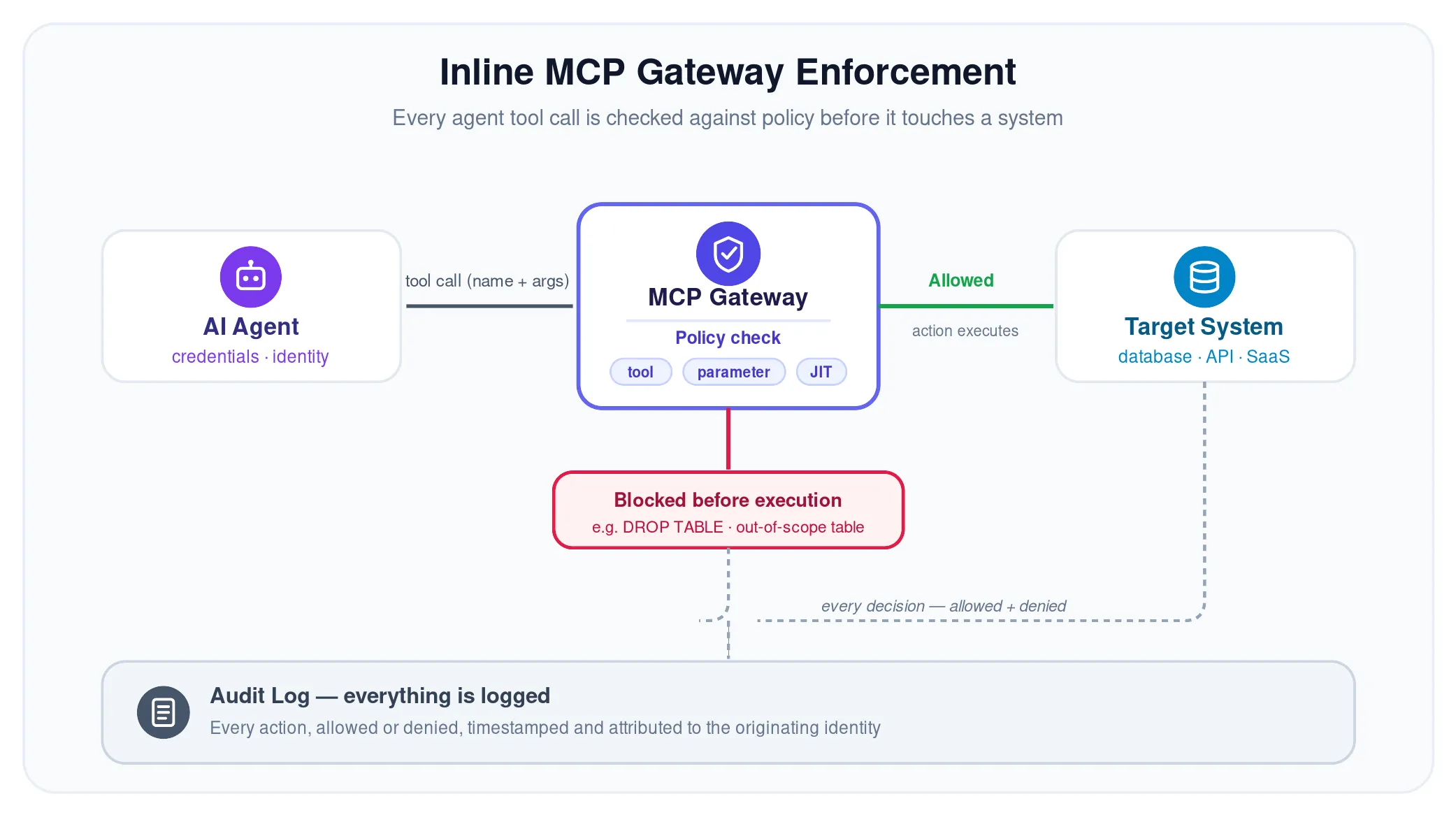
Controlling which systems an agent can reach isn't enough, and neither is controlling which tool it calls. A single tool can be harmless or catastrophic depending on its arguments: execute_sql with a SELECT is routine; the same tool with DROP TABLE is not. Real least privilege reaches the parameter level — allowed values, table and scope allowlists, row limits, response redaction — not just the tool name. In practice, a well-scoped policy looks like this: allow the query tool, permit only SELECT statements, restrict it to two named tables, and cap the response at 100 rows, all evaluated on the single tool call before it runs. An inline MCP gateway is the natural enforcement point here, because it's the only layer that sees the full tool call, arguments included, before it executes.
4. Inline enforcement at the point of action
Control that operates after the fact, such as through logs or periodic review, is too slow for agents acting at machine speed. This is the function of an MCP gateway: a real-time layer between AI platforms and the applications they reach through the Model Context Protocol. When an agent makes a tool call, the gateway evaluates it against policy, approves or blocks it, and logs the decision, all before it reaches the target system. Inline enforcement is what makes AI access control operational rather than aspirational.
5. Just-in-time access for AI agents
JIT access replaces standing agent privileges with time-bound, scoped access granted per task and revoked automatically when the task completes. If an agent needs to write to production for one workflow, JIT grants it for the duration and removes it immediately after, thus shrinking the window of exposure if the agent is compromised.
6. Continuous monitoring and audit trails
Every agent action — approved or denied — should be captured, timestamped, and traceable to the identity behind it, human or non-human. Comprehensive audit trails enable incident investigation and provide the evidence needed for SOC 2, ISO 27001, and emerging AI-specific regulations.
How to Implement AI Access Control at Scale
The through-line across every practice below is one idea: agents cannot be governed in a silo. They act on behalf of humans, use service-account credentials, and touch the same systems every other identity does. Governing them separately gives you an incomplete view of risk.
Extend your existing identity program to cover agents — don't build a parallel one
AI access control is an extension of your identity governance and ISPM into a new layer. The same access profile logic, policy framework, and certification workflows that govern humans should extend to agents. A parallel agent-only stack produces fragmented visibility and inconsistent enforcement.
Govern humans, non-human identities, and agents on one plane
Agents act on behalf of humans, use service account credentials, and touch the same systems that human and non-human identities access. Therefore, effective AI access governance requires a unified identity model where every entity (human, non-human, and agent) is visible, governable, and subject to consistent policy. This is what an identity graph enables — correlating every identity, entitlement, and relationship so policy decisions reflect full context.
Cover the full credential surface
MCP, API keys, OAuth tokens, service accounts, and cloud IAM roles each grant agents a path into enterprise systems. MCP is fast becoming the standard for agent-to-tool communication, which makes gateway enforcement critical, but a complete strategy covers every credential surface, not just the newest protocol.
Start with high-risk workflows, then scale
Begin with agents that carry the most risk: write access to production, access to sensitive data, permissions in regulated environments. Establish AI access controls for those workflows first, demonstrate value, and then expand coverage systematically. Trying to govern every agent at once leads to stalled deployments and governance fatigue.
AI Access Control Best Practices
The following practices reflect what mature AI access governance programs are converging on.
Treat every agent as an identity with a lifecycle — onboard, review, and decommission it like any human or non-human identity.
Default to deny — start with no access; grant only what each task justifies.
Enforce policy inline, at the point of action — not reconstructed from logs later.
Unify agent governance with your existing identity program — one platform, one policy framework.
Apply tool- and parameter-level granularity — control the arguments, not just the tool.
Audit every action, including denials — denials reveal misconfigurations and abuse.
Key Takeaways
- AI access control governs what AI agents can access and do inside enterprise systems — one of the fastest-growing priorities in identity security.
- 97% of organizations that suffered an AI-related breach lacked proper AI access controls (IBM, 2025). The gap is real and measurable.
- Agents are identities and they often act on borrowed ones, which makes attribution the hard problem. They require the same governance rigor as humans and non-human identities.
- Inline enforcement at the tool-call level is what makes controls operational. Without it, policy exists on paper but not in practice.
- Start with high-risk workflows and scale from there.
- AI access governance should live inside your existing identity platform, not a separate silo. Unified visibility across humans, NHIs, and agents is essential.
Building an Identity Program That Governs AI
AI access control is not a future problem. Agents are already operating inside enterprise systems at scale, and the gap between deployment velocity and governance maturity is widening.
The core principle hasn't changed: see every identity, enforce least privilege, keep an auditable record of every action. What changes with agents is the speed, the scale, and the enforcement mechanism. Policy has to operate inline, granularity has to reach the tool call, and governance has to span humans, non-human identities, and agents on one platform. That is the approach organizations take with Linx, which extends unified agentic identity governance and real-time MCP gateway enforcement into the same platform that already governs human and non-human identities.
Ready to see what AI access control looks like in practice? Get a demo and watch every agent action get governed in real time, without slowing AI adoption.
AI Access Control FAQ
What is AI access control?
AI access control is the set of policies, processes, and enforcement mechanisms that govern what AI agents can access, invoke, and modify inside enterprise environments. It covers discovery, least privilege, inline enforcement, just-in-time access, and continuous monitoring for autonomous AI systems.
How is AI access control different from traditional IAM?
Traditional IAM was built for human users who request access through defined processes and whose entitlements change at a pace periodic reviews can manage, while AI access control addresses entities created programmatically that operate at machine speed and act continuously across systems. It requires real-time enforcement, tool- and parameter-level granularity, and lifecycle management for agent identities — where traditional IAM relies on periodic certification.
Do AI agents need their own identities?
Yes, AI agents need their own identities. Agents authenticate with credentials, hold permissions, and take consequential actions. They should be treated as identities with defined access profiles, lifecycle governance, and audit trails — just like human users and non-human identities such as service accounts and API keys.
What is an MCP gateway?
An MCP gateway is an inline enforcement layer between AI platforms and the applications they reach through the Model Context Protocol. It inspects every tool call an agent makes, evaluates it against policy, and approves or blocks the action before it executes — providing real-time control, tool-level granularity, and full audit logging for agentic workflows.
Does Zero Trust apply to AI agents?
Yes, zero trust applies to AI agents. Never trust, always verify, enforce least privilege — applied to agents, this means authenticating on every request, granting only the minimum access each task needs, and logging every action to an attributable identity. AI access control is how organizations operationalize Zero Trust for the agentic layer.
What is the difference between AI access control and AI governance?
AI governance is broader than AI access control and includes model safety, bias mitigation, data governance, regulatory compliance. AI access control is the identity and access dimension of that challenge: controlling what agents can access and do inside enterprise systems. Most organizations start with AI access control because access is the most immediate and measurable risk.
How do you enforce least privilege for AI agents?
Enforcing least privilege for agents requires three things: right-sized access profiles that match the agent's actual task (not broad, inherited credentials), tool-level granularity distinguishing read/write/admin actions, and just-in-time access granted per workflow and revoked automatically. Default to deny, and grant only when the workflow justifies it.
What should you look for in an AI access control solution?
When considering AI access control tools, you should look for inline enforcement at the tool-call level (not just post-hoc monitoring), tool- and parameter-level granularity, unified governance across human, non-human, and agent identities in a single platform, just-in-time access for agent workflows, full audit logging with attribution, and integration with your existing identity governance and ISPM.
How do you secure AI agents in the enterprise?
Securing AI agents starts with treating them as identities: discover every agent in your environment, assign each a scoped identity, enforce access policy in real time through inline controls like an MCP gateway, and keep complete audit trails of every action. Integrate this into your broader identity security program rather than running it as a separate initiative.
What are AI access control best practices?
Treat every agent as an identity with a full lifecycle, default to deny, enforce policy inline at the point of action, unify agent governance with your existing identity program, apply tool- and parameter-level granularity, and audit every action including denials. Start with high-risk workflows and scale systematically.
What's next?