



- Authentication Isn't Authorization: OAuth, OIDC, and SSO confirm an agent's identity but say nothing about which tools, actions, or data it should be allowed to touch.
- Server-Level Control Isn't Granular Enough: One MCP server can expose tools with very different risk levels, so policy has to work at the tool and action level, not just the connection level.
- The Regulatory Clock Is Running: EU AI Act high-risk rules take effect August 2026, and Gartner expects 25% of enterprise GenAI apps to see at least five minor security incidents a year by 2028.
- Every Agent Needs a Human Owner: Audit trails only hold up if every tool call traces back to an accountable identity, not a generic service account.
MCP gateways give enterprises a control point for AI agent traffic, but authentication and routing alone don't solve the deeper governance problem: knowing who is behind an agent, what it should actually be allowed to do, and maintaining a full audit trail tied to real human identities. Without tool-level enforcement, identity lifecycle management, and inline real-time inspection, organizations end up with agents that have far broader access than any individual person they represent, no deprovisioning process when that person leaves, and no attributable record of what the agent did in their name.
Your MCP Gateway Has an Identity Blind Spot
AI agents have moved from pilots to production. They are no longer summarizing documents or drafting emails — they are reading records, writing data, querying databases, and calling APIs inside the systems your business runs on. The Model Context Protocol (MCP) is the most popular way to connect them to those systems, and an MCP gateway is the control plane that sits in between.
But here's what most security teams discover after deploying one: a gateway alone doesn't provide you with governance. It handles authentication and enforces rules. What it doesn't answer are the identity questions that actually keep CISOs up at night — who is this agent acting on behalf of, what should it be allowed to do, and what did it actually do? Those are identity problems. And most MCP gateways weren't built to solve them.
What Is an MCP Gateway?
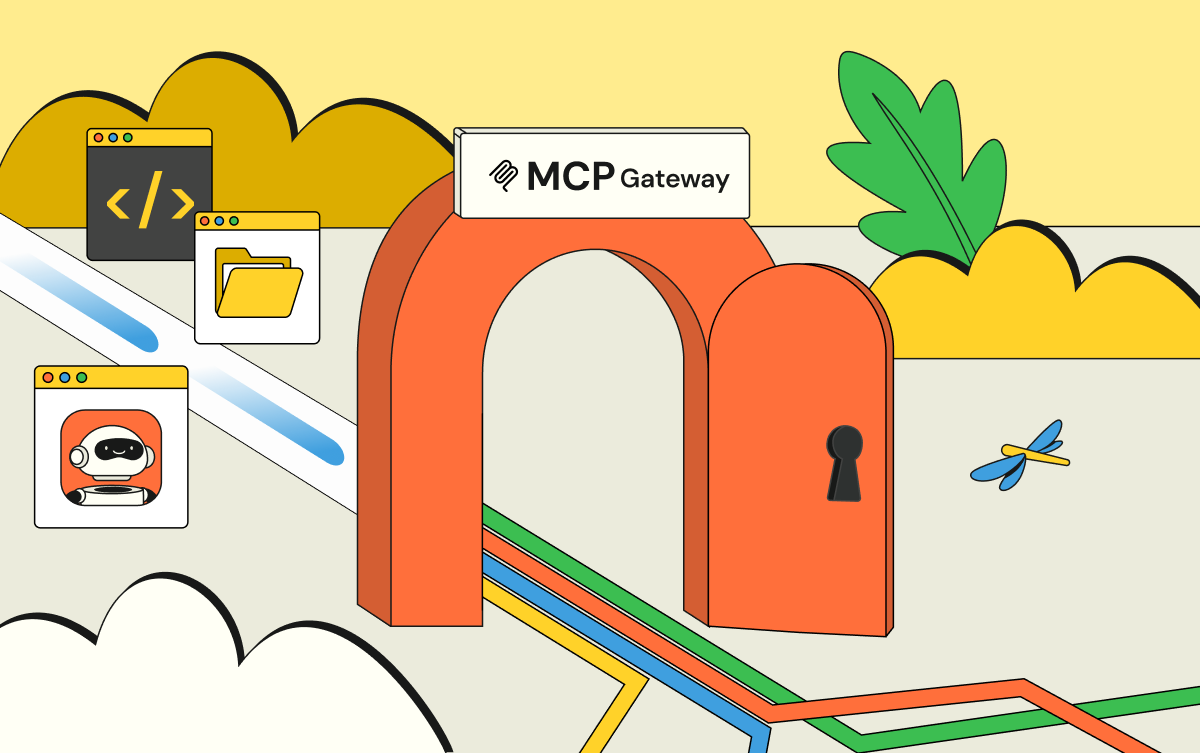
An MCP gateway is a control plane that sits between AI clients — Claude, Cursor, ChatGPT, internal agent frameworks — and the MCP servers those clients connect to. Every tool call an agent makes passes through it. The gateway's job is to enforce who can reach what, inspect traffic in both directions, log activity, and route requests to the right upstream system.
Think of it as the equivalent of an API gateway, but purpose-built for the MCP protocol. Where a generic API gateway understands HTTP methods and endpoints, an MCP gateway understands tool calls, resource requests, and the context in which agents invoke them. That protocol-level awareness is what separates a real gateway from a proxy with some auth bolted on.
For enterprise security teams, an MCP gateway is the foundational infrastructure layer for governing AI agent activity — but it is the starting point, not the finish line.
What MCP Means for the Enterprise Attack Surface
MCP has become the dominant integration layer for connecting AI agents to enterprise data and tools. It is supported by Anthropic, OpenAI, Google, and Microsoft, and as of early 2026, the official MCP registry lists thousands of registered servers, with tens of thousands more available through community directories. Gartner predicts that 40% of enterprise applications will be integrated with task-specific AI agents by the end of 2026, up from less than 5% in 2025.
That scale creates a new attack surface. Agents don't browse — they act. An agent connected to your Salesforce, GitHub, and Jira instances through MCP isn't reading information for a human to evaluate. It is making decisions, executing tool calls, and producing effects in your production systems. The blast radius of a misconfigured or compromised agent is no longer theoretical.
Why Legacy Access Controls Can't See MCP Traffic
The access controls enterprises rely on today were built for a different threat model: human-initiated, session-based access, where a person logs in, does something, and logs out. Agents don't work that way. They operate at machine speed, autonomously, chaining multiple tool calls across multiple systems in a single session — and they don't appear in the downstream application logs your security team relies on.
When an agent calls a tool through MCP, that action doesn't surface in Salesforce's audit log. It doesn't appear in your SIEM. It isn't captured by your DLP. The audit trail simply doesn't exist without an inline enforcement point. According to McKinsey's 2026 AI Trust Maturity Survey of approximately 500 organizations, nearly two-thirds cite security and risk concerns as the top barrier to fully scaling agentic AI — outranking regulatory uncertainty and technical limitations combined. The NSA's AI Security Center reinforced that signal in May 2026, publishing formal guidance on MCP deployments that identified authentication failures and trust boundary vulnerabilities as active, structural risks in enterprise AI stacks.
The gap isn't theoretical. It is the default state for most organizations deploying MCP today.
The Enforcement Gap: Server-Level Control Isn't Enough
Many organizations deploying an MCP gateway configure it at the server level: this role can reach this MCP server, that role cannot. It's a reasonable starting point. It is not sufficient.
A single MCP server can expose dozens of tools with entirely different risk profiles. The Stripe MCP server exposes balance retrieval, charge creation, refund processing, and customer record access in the same package. A finance analyst with read-only responsibilities should be able to query balances. She should not be able to initiate a refund. An engineer troubleshooting an integration should see neither.
Server-level AI access control can't express that distinction. Without tool-level policy enforcement mapped to roles, teams, and personas, organizations face a binary choice: block AI adoption entirely, or accept ungoverned access at a scope far broader than any individual's actual job requires.
Agents Need Authorization, Not Just Authentication
The common mistake is treating MCP governance as an authentication problem. OAuth 2.1, OIDC, SSO integration — these verify that the agent is who it claims to be. They say nothing about what it should be allowed to do in this specific context, for this specific task, invoked by this specific person.
Real MCP governance requires authorization at granular scope: not just which server, but which tools within that server, which actions within those tools, and which data those actions can touch. And it requires that authorization to be enforced in real time, before the action executes, not logged after the fact when the damage is done.
The Identity Gap: Who Is Behind the Agent?
Here is where most MCP gateways stop, and where the real governance problem begins. A gateway that inspects tool calls but has no view into the identity behind them is enforcing policy on an entity it doesn't understand.
Agents are not users. They are not service accounts. They are a unique type of identity — acting on behalf of humans, operating under machine credentials, with permissions that frequently exceed those of the person who invoked them. Most IAM programs have no framework for that. There is no provisioning workflow, no access review cadence, no deprovisioning trigger when the employee behind the agent leaves or changes roles.
The questions no standalone MCP gateway can answer are the ones identity security posture management (ISPM) was built for:
- Who provisioned this agent and what is it authorized to do?
- Does its current access reflect least privilege, or has it drifted?
- When this employee's access was revoked, did the agent's access get revoked as well?
- Can you provide an auditor with a complete, attributable record of what this agent did and on whose behalf?
Without answers to those questions, MCP governance is incomplete regardless of how well the gateway is configured - the human context is an integral part of the equation.
What Identity-Aware MCP Governance Looks Like
Governance that actually closes these gaps requires connecting the MCP layer to your broader identity program. Here is what that looks like in practice.
Linx is the identity governance platform already running across your humans and non-human identities. The MCP Gateway extends that same program — same access profiles, same access reviews, same JML — to AI agents. Not a new silo. The IGA you already run, reaching one layer deeper.
Enforce at the Tool Level, Not the Server Level
Access policy should specify which tools within each MCP server a given role, team, or persona can invoke — and which actions within those tools are permitted. An agent operating under a read-only finance persona should be able to call retrieve_balance. It should not be able to call create_charge. That distinction needs to be enforced by policy at the gateway layer, mapped to the same access profiles that govern human identities.
AI governance done right means the same access profile model governing your humans and NHIs extends to agents — one policy framework, not three across your environment.
Inspect and Adjudicate Before the Action Executes
Every tool call should be inspected and approved or blocked before it runs. This sounds obvious. Most deployments don't do it. Logging after the fact tells you what happened; it doesn't prevent the harm. Inline, real-time enforcement at machine speed is what governance actually requires when agents are taking actions faster than any human can review them.
Build a Complete, Attributable Audit Trail
Every approved and denied tool call should be captured, timestamped, and tied back to the specific human identity, non-human identity, or agent that initiated it. Not a generic service account. Not an agent ID with no owner. A complete chain of attribution that connects the action to the person behind it.
Identity intelligence that spans human and machine identities makes this possible — and makes it investigable when something goes wrong.
Connect Agent Lifecycle to Your Identity Program
Agents should be provisioned, reviewed, and deprovisioned with the same rigor as human access. Identity lifecycle management that covers agents means access reviews include agent permissions alongside human ones, and offboarding a person also terminates the agent access they owned.
For high-sensitivity operations, JIT access for agents — scoped, time-limited permissions minted at task execution time rather than standing access — significantly reduces blast radius when an agent is compromised or misdirected.
Getting Ahead of the Problem
A gateway is the enforcement point. An IGA program is the context that makes enforcement accurate. Linx has both built in - not a gateway bolted onto identity, but identity governance that reaches the gateway layer.
Regulatory pressure is arriving. The EU AI Act's rules for high-risk AI systems begin enforcement in August 2026, making audit-grade records a hard requirement for any agent touching credit, employment, healthcare, or critical infrastructure data. The NSA's May 2026 guidance elevated MCP security from a best practice to a formal design consideration for any organization running agents against sensitive systems. Gartner separately flagged that 25% of enterprise GenAI applications will experience at least five minor security incidents per year by 2028, in part because MCP was built for interoperability first and security second.
Organizations that treat MCP governance as an identity problem — not just a network or protocol problem — will be significantly better positioned to meet these requirements. The gateway is the enforcement point. Identity is the context that makes enforcement accurate.
Linx MCP Gateway sits inline between AI clients and the enterprise applications they connect to, enforcing tool-level policy in real time, logging every action with full attribution, and extending the same identity governance framework that covers your human and non-human identities directly to your agents. One platform to manage all policies across your entire identity landscape, rather than a separate tool trying to govern AI in isolation.
Ready to see it in action? Get a demo and see how Linx closes the identity gap in your MCP governance program.
Frequently Asked Questions
What is an MCP gateway?
An MCP gateway is a control plane that sits between AI clients and the MCP servers they connect to, enforcing authentication, access policy, and audit logging for every tool call that passes through. It gives enterprise security teams a centralized point to govern what AI agents can reach, what actions they can take, and a complete record of what they did.
How does an MCP gateway differ from an API gateway?
An MCP gateway is purpose-built for the Model Context Protocol, meaning it understands tool calls, resource requests, and the agentic context in which they occur — not just HTTP methods and endpoints. Generic API gateways can proxy MCP traffic, but they lack the protocol-level awareness needed to enforce tool-level access policies or attribute actions to the human identity behind an agent.
How does an MCP gateway handle authentication?
Enterprise MCP gateways typically implement OAuth 2.1 with PKCE for the client-facing layer, integrated with your existing identity provider via OIDC or SAML for SSO. On the upstream side, a gateway brokers credentials on behalf of users — storing them server-side and exchanging them per tool call — so the AI client never holds raw credentials for downstream systems.
What are the security risks of deploying AI agents without an MCP gateway?
Without an MCP gateway, agents connect directly to MCP servers with no centralized enforcement point, creating credential sprawl, no audit trail, and no ability to block unauthorized tool invocations before they execute. Actions taken through MCP don't surface in downstream application logs, meaning security teams have zero visibility into what agents are doing inside business-critical systems.
How does MCP gateway governance relate to identity and access management?
MCP gateway governance is an extension of IAM into the agentic layer. Every agent is a non-human identity that needs to be provisioned, governed with least-privilege access, reviewed periodically, and deprovisioned when its owner leaves. An MCP gateway that isn't connected to your IAM program can enforce who reaches what, but it cannot answer who authorized this agent, whether its access is still appropriate, or what happens to its credentials when an employee is offboarded.
What should enterprises look for when evaluating an MCP gateway?
Enterprises should prioritize tool-level access control over server-level allow/block, inline real-time enforcement before actions execute, full audit logging with human identity attribution, and integration with their existing identity provider and access profiles. Gateways that operate in isolation from the broader IAM program create a separate governance silo — the strongest posture extends the same policy logic governing humans and non-human identities directly to agents.
What is AI access control?
AI access control is the practice of defining and enforcing what AI agents are permitted to do within enterprise systems — not just which systems they can reach, but which specific tools, actions, and data they can interact with. Effective AI access control operates at the tool level, maps to role-based access profiles, and enforces policy in real time before agent actions execute.
What are AI access control tools?
AI access control tools are platforms that govern what AI agents and AI-driven systems are authorized to access across your environment. They cover discovery (finding every agent, including shadow deployments), AI identity governance (enforcing least privilege and just-in-time access for non-human identities), inline enforcement (blocking unauthorized actions as they happen), and monitoring (tracking what agents do with the access they hold).
How does AI access control differ from traditional access control?
Traditional access control governs human-initiated, session-based access to resources. AI access control must govern machine-speed, autonomous, multi-step tool invocations made by agents that act on behalf of humans but under their own credentials. This requires enforcement at a finer granularity — individual tool calls rather than application logins — and attribution logic that connects agent actions back to the human identity behind them.
What is AI governance in enterprise security?
AI governance in enterprise security is the set of policies, controls, and processes that organizations use to ensure AI systems operate within defined boundaries, with appropriate oversight and accountability. For agentic AI, this includes inventorying AI agents as identities, enforcing least-privilege access, maintaining auditable records of agent activity, and integrating agent lifecycle management into existing identity and security programs.
How do you implement AI governance for AI agents?
Implementing AI governance for agents starts with treating each agent as a first-class identity: discover and inventory all agents in your environment, define access policies at the tool level mapped to roles and personas, enforce those policies inline at the MCP gateway layer, and connect agent lifecycle — provisioning, access review, and deprovisioning — to your existing identity governance program. Audit logging with full human identity attribution is non-negotiable for regulated environments.
What's next?