


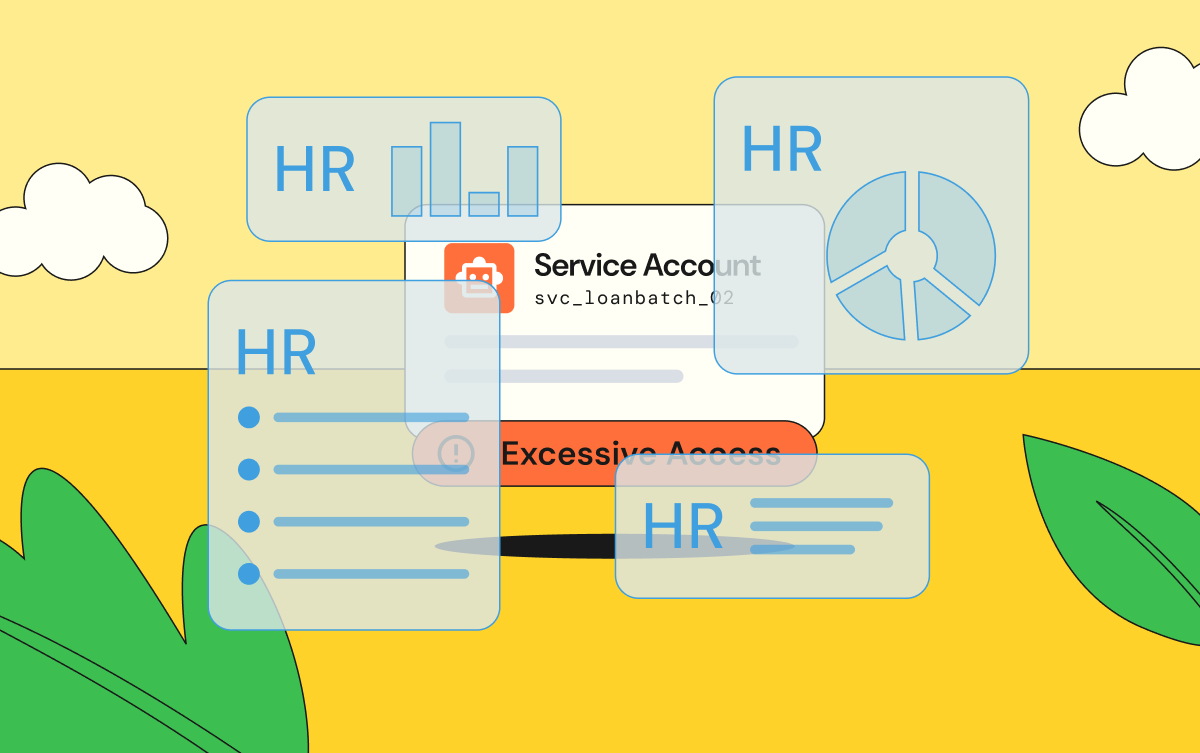
- HR systems are a valuable source of workforce data, but they can’t see the service accounts, machine identities, and AI agents that now make up much of the identity attack surface.
- Non-human identities and AI agents often hold broad permissions, lack clear ownership, and never appear in an HR directory.
- Identity governance offered as a feature inside a larger business platform rarely covers the full scope of enterprise identity risk.
- Access risk usually appears after provisioning, so governance has to be continuous rather than tied to lifecycle events and scheduled reviews.
- Modern IGA should combine three capabilities: discovering every identity, securing access with continuous context, and governing and remediating risk.
- Identity security should integrate with HR, IdP, and ITSM tools without depending on any one of them to define its limits.
For decades, identity governance has been built around a relatively straightforward process. An employee joins an organization, HR creates a record, IT provisions access, and eventually, when that employee changes roles or leaves, their access is updated or removed.
That model became the foundation for traditional identity governance and administration (IGA). HR systems served as the authoritative source for workforce information, while identity governance platforms helped organizations manage provisioning, certifications, and employee access throughout the lifecycle.
It worked for the world it was designed to serve. But that world looks very different today.
Enterprises now operate with an expanding universe of identities that extend far beyond their employees. Service accounts connect critical applications. Machine identities authenticate workloads and automate processes. AI agents access enterprise data, interact with business systems, and increasingly execute actions that once required human intervention.
These identities don't have employee records, job titles, or traditional reporting structures. They don't join through onboarding, and they don't necessarily leave when someone updates an HR system. Yet they can hold extensive permissions, access sensitive information, and introduce significant security risks.
Your HR system can tell you who works for your organization. It cannot tell you everything that they have access to.
That's the fundamental problem with treating identity security as an extension of HR technology. The enterprise identity attack surface has expanded beyond the workforce, and the systems responsible for securing it must evolve accordingly.
The Identity Attack Surface Has Outgrown the Employee Directory
HR systems remain important to identity governance. They provide essential information about employees, organizational relationships, and lifecycle events. That information supports access provisioning, role changes, and deprovisioning, and it will continue to play an important role in managing workforce identities.
But HR data is only one piece of a much larger identity security picture.
Consider the non-human identities operating across a typical enterprise. Service accounts maintain integrations between applications. API keys enable systems to exchange data. Cloud workloads authenticate to infrastructure and services. Automated processes execute tasks without direct human involvement.
These identities are often created outside formal provisioning workflows. Their permissions may accumulate over time, ownership can become unclear, and access can persist long after the original business purpose has disappeared.
(adding to this complexity is the introduction of a new class of identities, AI Agents) Now introduce AI agents.
Unlike traditional service accounts, AI agents can (are able to) operate with increasing autonomy. They may retrieve sensitive information, interact with multiple applications, invoke tools, execute workflows, or (even) take action on behalf of employees and business systems. Their access requirements can change depending on the task they're performing, and the implications of excessive permissions can extend well beyond a single application.
An AI agent doesn't need an employee record to access customer information. A machine identity doesn't need a manager to accumulate administrative privileges. And (similarly, ) a service account doesn't become less risky simply because it never appeared in an HR directory.
This creates a fundamental challenge for HR-centric identity governance. HR platforms are designed to understand people and their relationship to an organization. They are not inherently designed to discover every machine identity, evaluate AI agent permissions, or continuously assess identity risk across cloud and enterprise infrastructure.
The problem isn't that HR systems are failing. It's that identity security has become a much bigger responsibility than HR was ever designed to manage.
Identity Security Cannot Be Just Another Enterprise Software Feature
Enterprise technology is consolidating. Organizations want fewer vendors, better integrations, and more value from the platforms they already use. It's understandable that identity governance capabilities are increasingly appearing within broader enterprise software offerings.
But having identity governance functionality and having a comprehensive identity security strategy are not the same thing.
An HR platform may provide valuable employee lifecycle information. An identity provider may manage authentication and access. An IT service management platform may orchestrate requests and approvals. Each plays an important role, but none of those individual functions represents the full scope of enterprise identity security.
Identity security requires visibility across applications, cloud environments, directories, infrastructure, and every identity capable of accessing them. It requires understanding permissions, ownership, risk, and the relationships between identities and resources. (perhaps most importantly, ) It requires continuous governance and the ability to remediate inappropriate access. (from the same system)
Most importantly, it must operate independently of where an identity originated.
When identity governance becomes a secondary capability within a larger business platform, organizations need to ask whether that capability can truly address the breadth of their identity attack surface. Can it discover non-human identities that have no relationship to HR? Can it (is it able to)evaluate permissions granted to AI agents? Can (Does) it identify excessive access across systems outside its native ecosystem? Can (will) it connect governance decisions to security risk and remediation?
These are not edge cases. They are increasingly central to enterprise security.
Identity security cannot be defined by the capabilities of a single HR platform, identity provider, or enterprise application. Its scope must be determined by the identities, permissions, and risks that exist across the organization.
Identity security is not an HR function with additional security features. It is a security discipline that requires its own strategy, visibility, and controls.
We Cannot Move Backward to Employee-Centric Governance
For years, the identity industry has worked to move beyond static, employee-centric governance. Traditional IGA platforms focused heavily on scheduled access reviews, predefined roles, and lifecycle events. Those capabilities remain necessary, but they were developed for environments where identity changes were more predictable.
Today's identity environment is anything but predictable.
Access changes continuously. New applications are introduced, permissions accumulate, machine identities multiply, and AI agents are deployed into workflows that previously required human intervention.
An employee can be provisioned correctly and still accumulate unnecessary access over time. A service account can retain administrative privileges long after its original purpose disappears. An AI agent can (may) be granted access to multiple systems even when its assigned task requires only a fraction of those permissions.
In each case, the original access provisioning process may have worked exactly as intended. The security risk emerged afterward.
This is why governance cannot end when access is granted. Organizations need continuous visibility into how identities are configured, what permissions they hold, whether those permissions remain appropriate, and what actions are necessary when risk is identified.
Returning to an HR-centric approach as the primary model for identity governance would be a step backward. It would reinforce the assumption that identity security begins and ends with the employee lifecycle, precisely ( at a moment) when the industry needs to expand its understanding of what constitutes an identity.
The future of IGA isn't about bringing more identity security functionality into HR systems. It's about bringing identity governance closer to security.
Modern IGA Must Do More Than Govern Access
The next generation of IGA isn't about abandoning traditional governance. Organizations still need user access reviews, lifecycle automation, access requests, separation of duties, and audit evidence. Those requirements remain essential to managing access and demonstrating compliance.
But modern IGA must extend beyond executing governance workflows. It needs to combine three fundamental capabilities: discovering identities, securing access, and governing permissions continuously.
Discover Every Identity
You cannot secure an identity you don't know exists.
Modern identity security begins with comprehensive discovery across SaaS applications, cloud environments, directories, and enterprise infrastructure. That includes human identities, non-human identities, and AI agents, regardless of where they originate or how they authenticate.
Discovery must also establish (reliabl)context. Security teams need to understand who or what owns an identity, which resources it can access, what permissions it holds, and how it connects to other systems and identities.
An inventory of accounts is useful, but it isn't (is insufficient) sufficient. Organizations need a connected understanding of their entire identity attack surface.
Secure Access With Continuous Context
Discovering identities is only the beginning. Organizations must also understand whether the access those identities possess introduces risk.
That means identifying excessive permissions, orphaned accounts, dormant identities, risky access relationships, and inappropriate privileges. It also requires recognizing that access which was appropriate yesterday may no longer be appropriate today.
This becomes especially important with non-human identities and AI agents, where traditional employee-based signals may not exist. Security teams need to evaluate access based on ownership, permissions, activity, context, and the potential impact of misuse.
Modern identity security must continuously surface and prioritize (an remediate) meaningful risks rather than relying exclusively on periodic reviews or manual investigations.
Govern and Remediate
Visibility and risk detection matter, but neither reduces exposure on its own.
Organizations need to translate identity security findings into action. Access reviews should provide meaningful risk context. Lifecycle processes should remove unnecessary permissions. Governance workflows should support timely remediation, and security teams should be able to address identified issues without creating another lengthy manual project.
For AI agents, governance must also account for what those identities are authorized to do, not simply whether they exist in an inventory.
Discovering risk, understanding its implications, and taking action should be part of one continuous process.
Discover. Secure. Govern.
These capabilities shouldn't be disconnected tools or isolated workflows. They should operate together (in a common platform) as the foundation of modern identity security.
Your Identity Security Strategy Should Be Bigger Than Your Technology Stack
Enterprise environments are rarely built around a single technology provider. Organizations operate across multiple cloud platforms, identity providers, HR systems, business applications, and infrastructure environments. (Mergers and) Acquisitions introduce additional systems, business units adopt new technologies, and AI continues to create new ways for identities to access enterprise resources.
An effective identity security strategy must work across all of them.
It shouldn't require every identity to originate in the same HR system, every application to belong to the same software ecosystem, or every access decision to follow a traditional employee lifecycle.
And it certainly shouldn't require organizations to rethink their identity security strategy whenever they change a major business application.
This doesn't mean identity security should operate separately from existing enterprise technology. Integration is essential. HR platforms provide valuable workforce context, identity providers support authentication, and IT service management systems facilitate workflows. A modern identity security platform should work with all of them.
But integration and dependency are fundamentally different.
Identity security needs to maintain its own enterprise-wide visibility, risk context, governance capabilities, and remediation processes. It should bring information together from across the technology environment rather than inherit the limitations of any individual system.
Your HR system should inform your identity security strategy. It shouldn't define its limits.
As the number and variety of enterprise identities continue to grow, this distinction will become increasingly important. Organizations need a security strategy that evolves with their identity attack surface, not one constrained by the boundaries of their existing enterprise software investments.
Identity Security Is What We Do at Linx
At Linx Security, we believe identity security deserves more than a supporting role in another technology platform.
It's not an HR feature. It's not simply an extension of authentication. And it's not a collection of access reviews performed a few times a year.
Identity security is what we do. It's what our platform is built for, and it's the problem we're focused on solving.
Linx brings modern identity governance and administration (IGA) and identity security posture management (ISPM) together in one unified platform. We help organizations discover, secure, and govern their entire identity attack surface, including human identities, non-human identities, and AI agents.
That means organizations can automate user access reviews, streamline identity lifecycle management, identify excessive privileges, uncover orphaned and dormant accounts, and continuously evaluate identity risk without managing separate solutions for every identity type.
And we don't believe identifying a problem should be where identity security stops. Linx connects visibility and risk context with automated remediation, helping organizations move from knowing where they're exposed to actually reducing that exposure.
We integrate with the HR systems, identity providers, cloud environments, and business applications enterprises already rely on. But our platform isn't limited by any one of them. Our focus is on securing identities wherever they exist, regardless of whether they're employees, service accounts, machine identities, or autonomous AI agents.
We aren't trying to turn an HR platform into an identity security solution. We're building identity security for the enterprise as it exists today and the one that's coming next.
And we believe organizations should expect nothing less.
Your Identity Security Deserves More. So Why Settle?
Identity security has become one of the most important responsibilities in enterprise security, and its scope is only expanding.
Human identities are no longer the whole story. Non-human identities already operate throughout enterprise environments, and AI agents are introducing new levels of autonomy, access, and complexity. Traditional employee-centric governance cannot address that entire landscape on its own.
Organizations need more than identity governance as an additional feature within a larger business platform. They need a purpose-built solution that delivers the governance capabilities they depend on while continuously discovering identities, identifying risk, and driving remediation across the enterprise.
This is exactly what Linx Security was built to deliver.
We don't do HR. We do identity security.
Human identities. Non-human identities. AI agents. One unified platform to discover, secure, and govern them all.
If you're evaluating your identity governance strategy, replacing legacy IGA, or looking for a platform that can secure your entire identity attack surface, it's time to take a closer look at Linx.
See what modern identity security looks like with Linx Security.
What's next?