

Linx vs. Lumos

Govern identity with entitlement-level depth
Lumos is a SaaS access management tool built on IdP-level data, while Linx ingests fine-grained entitlement data directly from every connected system, human and non-human, cloud, SaaS, on-prem, and custom apps, with the AI and in-platform remediation to act on what it finds.
Book a demo
Last updated: September 2026
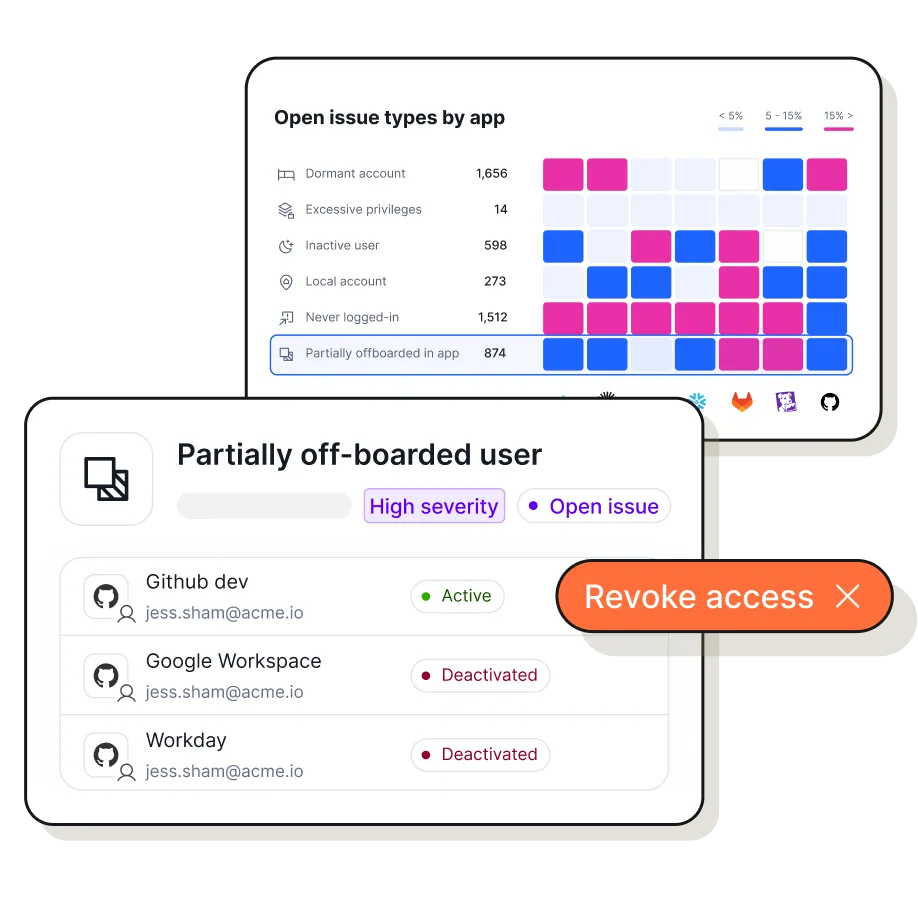
Security dashboard shows an issue-status grid and “Partially off-boarded user” panel with active and deactivated apps, plus a red “Revoke access” button.
Built for and trusted by leading enterprises
Green bushes with a blue flower on the left and an orange flower on the right on green grass.

Compare Linx and Lumos

Lumos

Core focus
Unified identity security & governance platform, ingesting fine-grained entitlement data across every system.
A SaaS access management platform with a self-service access request experience.
Non-human &
agentic identity
Native, typed governance for service accounts, API keys, and AI agents, each governed by one unified policy.
Discovers NHIs but with limited visibility and no differentiation by type.
Risk detection
Orphaned accounts, dormant users, MFA gaps, and access granted outside the platform surfaced natively.
No dedicated ISPM layer. Identifying risk means asking the AI assistant or launching a full access review.
Remediation
One-click, in-platform remediation from the point a risk is identified.
Access reviews are the primary remediation path; no direct one-click fix from a risk finding.
AI capabilities
Platform-wide, working across deep entitlement data: continuous data refinement, a context-aware assistant, and autonomous remediation through Autopilot.
Albus AI assistant, scoped primarily to IdP-level signals like group membership and last login rather than fine-grained entitlements.
Identity graph
Interactive visual map of every identity, relationship, permission, and risk.
No dedicated graph view — relationships have to be pulled by asking the AI assistant.
Integration depth
Deep — ingests full entitlement data from each connected system, not just IdP-level user records.
Pulls basic user and app-assignment data from the IdP only, rather than fine-grained entitlements.
Customer rating
Methodology
This comparison was compiled in September 2026 using vendor product documentation, official press releases, third-party analyst and review sources, and hands-on evaluation of both platforms. Both platforms ship frequently; we review and update this page quarterly.

Why IT and security leaders prefer Linx

“In a matter of weeks with Linx, we've been able to quickly identify risky accounts, risky privileges, and be able to automate the remediation of all of those things.”

Aaron Ballio
Aaron Ballio
CISO,
Utilities company

“With Linx, we can remediate and take action when needed, allowing us to really save teams time by automating workflows so we could focus on things that really matter.”

Jeff Farinich
Jeff Farinich
SVP Technology & CISO, New American Funding

“Linx gave us the visibility we didn't know we were missing. It wasn't just a dashboard. It actually did something.”

David Silva
David Silva
CIO,
SmartCentres

“Since implementing Linx, the data that we provide to auditors is just better. The process has improved. The amount of time to deliver evidence has improved exponentially.”

Dan Loveman
Dan Loveman
Sr Director of IT Security,
Evolv

“We can see all the agents that are in use and what access they have to what application and data source. It is a full security and governance platform.”

IAM Lead
IAM Lead
Technology company

“The implementation is straightforward, and allows us to gain meaningful visibility into identity risk much faster than expected.”


Director of IT Security
Technology company
Green hills with a gradient fade to white below against a black background.Green hills with a gradient fade to white below against a black background.CloudCloud

How Linx and Lumos differ

Linx ingests entitlement data directly from each connected application — not just that a user has access to a system, but what they can actually do inside it: which records, which permissions, which actions. Every other capability in Linx, from risk detection to AI recommendations, is built on that deeper layer.

Diamond Icon
The Linx benefit
Risk analysis and AI recommendations are grounded in what a user can actually do, not just which app they're assigned to.
vs
Lumos

Lumos's data model is built around only what the IdP knows. That shallower data layer impacts everything else in the platform, including Lumos’s AI.

Linx governs service accounts, API keys, bots, and AI agents as typed, first-class identities under the same policy engine as human identities, through agentic identity governance, with the MCP Gateway controlling how AI agents reach the systems they act on.

Diamond Icon
The Linx benefit
As agentic AI becomes part of your identity estate, each type of NHI is governed on its own terms, not lumped into one bucket.
vs
Lumos

Lumos discovers NHIs during ingestion, but doesn’t differentiate by category and doesn’t map to relationships, owners, or risk context.

Linx treats ISPM as a continuous control. The platform maps every identity, entitlement, and resource on an ongoing basis and puts orphaned accounts, dormant users, admin sprawl, missing MFA, and access granted outside the platform in front of you natively.

Diamond Icon
The Linx benefit
Risk is surfaced automatically without you needing to look for it.
vs
Lumos

Lumos has no dedicated risk or issues view. Surfacing a problem means asking the AI assistant directly or launching a full access review to find it.

When Linx flags a risky entitlement, a dormant account, or partially offboarded user, the access revocation happens inside Linx through no-code, in-platform remediation. No separate review cycle required to act.

Diamond Icon
The Linx benefit
The gap between finding a risk and actually fixing it closes inside one platform.
vs
Lumos

When Lumos identifies a problem, the only path to fixing it is launching a full access review — there's no direct remediation from the point of detection.

Linx was built as an identity security and governance platform from the start. Access requests, certifications, user access reviews, and lifecycle policy run on the same modern IGA engine that holds the visibility data, so reviewers see why an entitlement is risky at the moment they approve it. That context is what stops reviews from being rubber-stamped.

Diamond Icon
The Linx benefit
Governance that runs as a daily process rather than an audit-season project.
vs
veza

Veza added access reviews, requests, and provisioning to a platform that began as a data access entitlement tool.

Why enterprises choose Linx as a Lumos alternative

Black broken chain-link icon with two curved connected loops centered on a bright yellow circle, conveying disruption or a severed connection.

Entitlement depth, not just visibility

AI recommendations and risk analysis are grounded in what users can actually do.

Orange broken chain-link icon with two curved connected loops centered on a bright yellow circle, conveying disruption or a severed connection.

Remediation that executes

Governance and posture in one platform with risk analysis and remediation features.

Black shield-shaped map pin icon with a small central circle and pointed bottom, centered on a bright green circular background; clean, modern tone.

Real governance for NHIs and agents

Service accounts, API keys, and AI agents governed as typed identities.

Blue circular icon featuring a bold black eye symbol with an outlined iris and pupil, conveying visibility, viewing, or privacy settings.

Risk surfaced proactively

Orphaned accounts, dormant users, and MFA gaps appear without launching a review.

Orange circular icon with three black outlined dots and a magnifying glass, suggesting search, discovery, or examining information; simple, bold design.

Full enterprise identity coverage

Cloud, SaaS, on-prem, and custom applications on one platform.

Bright green circle on a black background with four black arrows pointing inward from the corners, conveying focus, compression, or a minimize gesture.

Human, non-human, and agentic identities together

One policy engine, continuous drift monitoring.

Blue circular icon on a black background, showing a simple black-outlined robot with two eye dots and a rectangular body; clean, friendly design.

AI across the whole platform

A context-aware assistant and autonomous identity governance.

Black outlined five-point star icon centered in a bright yellow circle on a black background, creating a bold, cheerful, high-contrast design.

Rated 5/5 on Gartner Peer Insights

Loved by customers and backed by the reviews to prove it.

FAQs

Is Linx a good alternative to Lumos?

Yes, Linx is a good alternative to Lumos, particularly for organizations whose identity landscape goes beyond pure SaaS, or that need governance grounded in fine-grained entitlement data rather than IdP-level signals. Lumos's strength is a polished, approachable experience for SaaS-centric, cloud-only environments with self-service access requests. Linx adds native risk detection, in-platform remediation, real governance for non-human identities, and full coverage across cloud, SaaS, on-prem, and custom applications.

What is the main difference between Linx and Lumos?

Lumos and Linx both provide identity governance, but the difference comes down to what data each platform sees. Lumos's data model is built around what the identity provider knows — group memberships, app assignments, last login — which is also the ceiling for its AI recommendations. Linx ingests fine-grained entitlement data directly from each connected application, so risk detection and AI recommendations reflect what a user can actually do in a system, not just that they're assigned to it.

Does Lumos detect risk natively?

No, Lumos does not natively detect risk. Lumos doesn't have a dedicated posture management layer, meaning there's no risks or issues view comparable to other IGA platforms like Linx or Saviynt. Finding a problem in Lumos means asking its AI assistant directly or launching a full access review.

How does Linx handle non-human and AI agent identities compared to Lumos?

Linx and Lumos handle NHIs and AI agent identities differently. Lumos discovers non-human identities during ingestion but groups them into a single "service account" category, without differentiating between service accounts, API keys, bots, and AI agents. Linx governs each of these as typed, first-class identities under the same policy engine as human identities, with the MCP Gateway controlling how AI agents reach the systems they act on.

Does Linx or Lumos cover on-premises and custom applications?

Both Linx and Lumos support on-premises and custom applications, but coverage varies. Lumos's core design focus is SaaS-first. Linx unifies cloud, SaaS, on-prem, and custom applications under one platform and policy engine from the start.

How do Linx and Lumos' AI agents compare?

Both Linx and Lumos' AI agents are powerful, but they differ in that Linx AI is built for autonomous action on fine-grained entitlement data while Lumos's Albus assistant answers questions within IdP-level context. Albus draws on group membership, app assignments, and last login, so its recommendations reflect what the identity provider knows. Linx AI works across three layers — continuous data refinement, a context-aware assistant on every page, and Autopilot – which acts on flagged risks rather than only surfacing them.

Illustration of leaves with an orange flower and a blue flower growing along a hillside.
Orange and yellow decorative flower illustrationBlue decorative flower illustration

Govern what Lumos
can’t see

Get a demo