

Linx vs. Veza
Close the loop, from risk to resolution
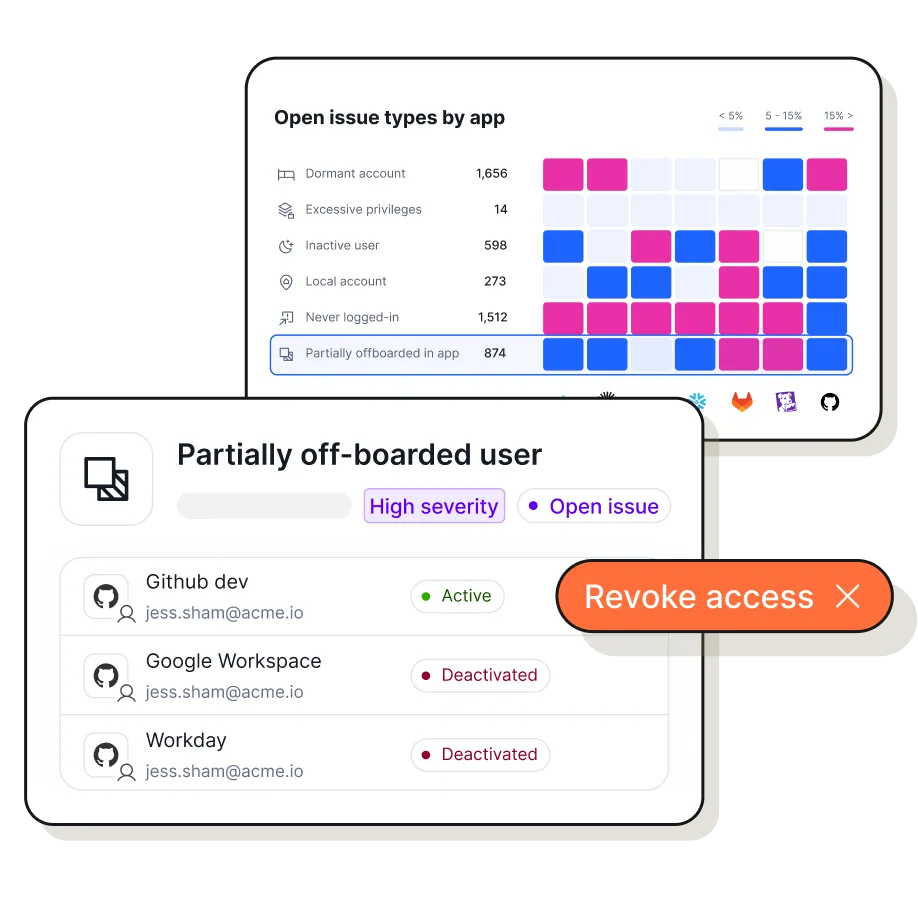












How Linx and Veza compare

veza

Why security leaders prefer Linx
“In a matter of weeks with Linx, we've been able to quickly identify risky accounts, risky privileges, and be able to automate the remediation of all of those things.”

“With Linx, we can remediate and take action when needed, allowing us to really save teams time by automating workflows so we could focus on things that really matter.”

“Linx gave us the visibility we didn't know we were missing. It wasn't just a dashboard. It actually did something.”

“Since implementing Linx, the data that we provide to auditors is just better. The process has improved. The amount of time to deliver evidence has improved exponentially.”

“We can see all the agents that are in use and what access they have to what application and data source. It is a full security and governance platform.”

“The implementation is straightforward, and allows us to gain meaningful visibility into identity risk much faster than expected.”




How Linx and Veza differ in practice

When Linx flags a risky entitlement, a dormant account, or partial offboarding, the fix happens inside Linx through no-code automated remediation. No ticket, no second system, no waiting on the team that owns the app.

Veza can confirm whether a revocation performed elsewhere actually took effect, but it can’t actually revoke access.
Linx treats ISPM as a continuous control. The platform maps every identity, entitlement, and resource on an ongoing basis and puts orphaned accounts, dormant users, admin sprawl, SSO bypass, and missing MFA in front of you natively, with no query language and no custom configuration required.
Veza ships 500+ pre-built queries and shared dashboards, meaning the risk you find depends on the query you thought to run.
Linx AI was built in from day one and operates in three layers. Data refinement runs continuously beneath the platform, an AI assistant works across any page to provide context for you and reviewers, and autonomous agents act through Linx Autopilot, which detects, evaluates, and resolves without waiting for a human to initiate it.
Veza’s AI is scoped to its Query Builder, translating plain English into a query.
Linx governs service accounts, API keys, bots, and AI agents under the same policy engine as human identities through agentic identity governance, applying least privilege, just-in-time access, and continuous drift monitoring, with the MCP Gateway controlling how AI agents reach the systems they act on.
Veza covers non-human identities through an NHI dashboard, credential discovery, GitHub secrets scanning, and ownership mapping.
Linx was built as an identity security and governance platform from the start. Access requests, certifications, user access reviews, and lifecycle policy run on the same modern IGA engine that holds the visibility data, so reviewers see why an entitlement is risky at the moment they approve it. That context is what stops reviews from being rubber-stamped.
Veza added access reviews, requests, and provisioning to a platform that began as a data access entitlement tool.
Why companies choose Linx as a modern Veza alternative

Remediation that executes
Find the risk, fix it, and confirm it without leaving the platform.

IGA and ISPM on one data model
Governance and posture in a single product, not two tools and an integration.

AI across the whole platform
Data refinement, an assistant on every page, and autonomous action through Autopilot.

Risk surfaced proactively
Orphaned accounts, dormant users, and MFA gaps appear without anyone running a query.

Usable without engineers
GRC and security teams operate it directly, no query language required.

Human, non-human, and agentic identities together
One policy engine, continuous drift monitoring.

Independent and platform-agnostic
No ecosystem commitment, works with the IAM stack you have.

Rated 5/5 on Gartner Peer Insights
Loved by customers and backed by the reviews to prove it.
FAQs
Is Linx Security a good alternative to Veza?
What is the main difference between Linx and Veza?
How does the ServiceNow acquisition of Veza affect existing customers?
Do Linx and Veza do the same things?
Do Linx and Veza both replace legacy IGA platforms like SailPoint or Saviynt?
Can Veza remediate risky access, or does it only report it?
Do you need to know a query language to use Linx?