

Linx Newsroom

Linx Security Extends Context-Driven Identity Control to Every AI Agent, Managed or Unmanaged
Four new capabilities bring shadow agent discovery, identity-aware runtime enforcement and automated governance to enterprise AI agents
Linx Security, the context-driven control platform for every human, NHI and agent identity, today announced four new capabilities that bring every agent under identity control, managed or unmanaged, in any gateway. Shadow AI Agent Detection finds the agents no one sanctioned. Agent Runtime Control decides every agent action in the gateway organizations already run. And for identity teams, Autopilots for any use case put governed agents to work, a first among major identity vendors, while Prompt-to-Workflow turns a plain-English description into a tested, agentic workflow. Together, these capabilities extend identity governance beyond managing access to controlling the actions AI agents take across the enterprise.
Agent Security Starts with Identity
Agents are created, get access and act at machine speed, while governance still runs on human time, through tickets, approvals and periodic reviews. Agents also break the controls built for people: they are ephemeral, spawned, renamed, modified and reactivated with little trace; they run without a script, so what they do next is hard to predict; and they act autonomously across company tools and data. Many are shadow AI, running on personal accounts, in pipelines and in AI apps outside sanctioned platforms, with no owner and no review. Gartner predicts that through 2028, over 50% of enterprise AI initiatives will halt due to unresolved agentic identity challenges.
Rather than treating AI agents as a separate security problem, Linx extends its existing identity governance architecture to every human, NHI and AI agent identity. Closing this gap takes more than discovering agents or monitoring their activity. It requires understanding each agent’s identity, permissions, relationships and actions in context, and Linx applies that context in three steps. Graph it: put every agent, sanctioned or not, on one Identity Graph alongside every human and NHI, with who owns it and whose access it carries. Decide with context: use that graph to weigh risk and set policy for every agent tool call and every access change. And control the action: enforce those decisions in whatever gateway agents run through, and give identity teams agents and agentic workflows of their own to carry out the work. Linx customers already govern more than 25,000 AI agent identities in production, and governed agent identities grew 450x in six months.
What's New
Shadow AI Agent Detection. Linx already inventories agents on the platforms where they're built. Shadow AI Agent Detection extends that to AI running outside them, from endpoints and CI/CD pipelines to SaaS and cloud. Each finding lands on the Linx Identity Graph with its owner, how it could be exploited and how to fix it, so security teams can govern shadow agents like any other identity.
Agent Runtime Control. Organizations can now bring their own gateway: Linx integrates with the AI gateway they already run and acts as its decision point, through the AuthZEN open standard. Organizations without one can use the Linx MCP Gateway. Every agent tool call is allowed or blocked based on who is behind it, its risk and what it is trying to do, without replacing existing infrastructure.
Autopilots for any use case. Identity teams can now add mission-specific team members. They give an agent a mission in plain language, set its scope, and choose which actions it takes on its own, which need human approval and which it never takes. Each Autopilot works from everything Linx knows about the organization's identities and access, and teams review its plan and dry-run it before turning it on.
Prompt-to-Workflow. Teams describe a workflow in plain English, such as deactivating an agent when its owner leaves. Linx builds each step, shows the code behind it and dry-runs it before it goes live.
Context Is the Control Point
"AI agents are fundamentally changing the identity security problem," said Israel Duanis, co-founder and CEO of Linx Security. "Enterprises need to know not just who has access, but what every identity is connected to, what it's doing and why. That context is the foundation we've built at Linx, and we're now extending it to every AI agent."
Meet Linx at Gartner IAM
See the new capabilities live at the Gartner Identity & Access Management Summit in Las Vegas, December 7–9, 2026. Visit the Linx booth or book time with our team.
About Linx Security
Linx Security delivers context-driven control for every human, NHI and agent identity. Linx connects every identity on one Identity Graph, turns relationships into informed decisions and enforces those decisions across access and actions, on one platform spanning Modern IGA, Identity Security Posture, Just-in-Time Access, Lifecycle, and Agentic and NHI Governance. Founded in 2023, Linx has raised $83M from Insight Partners, Index Ventures and Cyberstarts.

New York, N.Y. — October 21, 2026 — Linx Security, the AI-native identity security and governance platform, today announced the appointments of Lauren Ball as Senior Vice President of Sales and Cinthia Portugal as Senior Vice President of Marketing. The appointments mark the next phase of Linx's growth as the company expands its enterprise presence, strengthens strategic partnerships, and scales adoption of its platform for securing human, non-human, and AI agent identities.
The expansion follows growing enterprise adoption of Linx's identity security platform, which governs millions of identities globally and serves organizations including Aramark, GSK, Peloton, Discount Tire, Wiz, monday.com, and AlphaSense. Backed by $83 million in funding, Linx has secured multimillion-dollar contracts with banks, healthcare organizations, and Fortune 500 enterprises. The company is now investing in its global go-to-market organization to meet increasing demand for continuous identity governance and control.
The appointments also come as enterprises face growing complexity in managing identity risk. Gartner reports only 13% of organizations believe they have the right AI agent governance in place.¹ As organizations introduce more autonomous systems alongside human and non-human identities, Linx provides the continuous context needed to understand identity relationships, assess access risk, and govern actions across enterprise environments.
“Niv and I founded Linx to give enterprises the context and control to understand every identity, map its relationships, and govern the actions it takes,” said Israel Duanis, CEO and co-founder of Linx Security. “Our customers are already putting this vision into practice at enterprise scale. Lauren and Cinthia bring complementary experience in scaling enterprise sales and building markets. Together, they'll help us reach more organizations, strengthen our customer and partner relationships, and accelerate our next phase of growth.”
Powered by continuous context from the Linx Identity Graph, the platform connects three core functions: graphing identities and their relationships, deciding which access and actions to allow, and enforcing controls before actions execute. This unified operating model supports modern identity governance and administration (IGA), identity security posture management (ISPM), just-in-time access, and identity lifecycle management across human, non-human, and AI agent identities.
Recognized in Forrester's The Workforce Identity Security Platforms Landscape, Q4 2025 report³ and named a Representative Vendor in the 2026 Gartner® Market Guide for Identity Governance and Administration², Linx continues to expand its technology and partner ecosystem, spanning Anthropic, AWS, Google Workspace, GuidePoint Security, Microsoft Azure, Okta, Optiv, and Snowflake. The platform is also available for purchase through AWS Marketplace and the Microsoft Security Store Partner Ecosystem.
Ball brings extensive enterprise sales leadership experience across AuditBoard (now Optro), AppDynamics, and Intuit. Most recently, she served as Chief Sales Officer at AuditBoard, following roles as Senior Vice President of Global Sales and interim Chief Revenue Officer. Over more than five years with the company, she helped scale its enterprise sales organization and support its growth. At Linx, Ball will lead global enterprise sales, expanding strategic customer relationships, strengthening partner engagement, and accelerating adoption across large enterprises.
Portugal brings a proven track record of building and scaling global marketing organizations, shaping emerging cybersecurity categories, and driving enterprise growth across Zenity, Humio, and CrowdStrike. Most recently, she led global marketing at Zenity, playing a central role in establishing AI agent security as a distinct cybersecurity category and positioning the company as a market leader. At Linx, Portugal will lead global marketing, advancing category leadership, strengthening market influence, and translating the company's technical innovation and customer success into sustained demand and revenue growth.
About Linx Security
Linx Security provides an AI-native identity security and governance platform spanning human, non-human, and AI agent identities. Powered by the Linx Identity Graph, the platform combines continuous identity context, risk analysis, and automated remediation to help enterprises govern access and strengthen security across their environments. Founded in 2023 and headquartered in New York, Linx is backed by Insight Partners, Index Ventures, and Cyberstarts.
Research References
- Gartner, “Gartner Identifies Six Steps to Manage AI Agent Sprawl,” April 28, 2026.
- Gartner, Market Guide for Identity Governance and Administration, Rebecca Archambault et al., August 28, 2026.
- Forrester, The Workforce Identity Security Platforms Landscape, Q4 2025.
Gartner Disclaimer
Gartner does not endorse any vendor, product or service depicted in its research publications, and does not advise technology users to select only those vendors with the highest ratings or other designation. Gartner research publications consist of the opinions of Gartner's research organization and should not be construed as statements of fact. Gartner disclaims all warranties, expressed or implied, with respect to this research, including any warranties of merchantability or fitness for a particular purpose.
GARTNER is a registered trademark and service mark of Gartner, Inc. and/or its affiliates in the U.S. and internationally. All rights reserved.

Linx Recognized in the 2026 Gartner® Market Guide for Identity Governance and Administration
New York, N.Y. — September 21, 2026 — Linx Security, the AI-native identity security and governance platform, today announced it has been recognized as a Representative Vendor in full-suite vendors in the 2026 Gartner® Market Guide for Identity Governance and Administration (IGA).
Linx believes this recognition reflects the market's shift toward continuous, AI-driven identity governance — moving away from the periodic, manual access reviews that have defined legacy IGA, toward an approach that can keep pace with hybrid environments and the rapid growth of non-human and AI agent identities.
According to the report, IGA is evolving to meet this moment. The Gartner report recommends companies do the following when evaluating IGA vendors:
- Prioritize unified governance for all identity types: Gartner advises choosing IGA platforms that offer unified governance across all identity types, whether human, non-human, or agentic. Linx delivers this through its Identity Graph, which unifies human, machine, and AI agent identities into a single model, giving security and IT teams continuous visibility into who and what has access, how that access is used, and where risk is emerging.
- Implement AI runtime controls: Instead of relying on a loosely phased approach of generic guardrails for AI, the report says that cybersecurity leaders must get specific now about implementing precise AI runtime controls. Linx provides this through Agentic Access Control and an MCP Gateway, which let security teams govern and restrict the tools and data AI agents can reach in real time.
- Select an AI-enabled IGA platform: Gartner notes that as regulations and threats increase, AI-powered IGA platforms are becoming essential for managing and protecting all types of identities. Linx advances this through Autopilot, which automates the detection and remediation work that traditionally consumed identity teams' time during access reviews and certifications.
Israel Duanis, Co-Founder and CEO of Linx Security, said: "We built Linx because identity teams were being asked to govern a fundamentally new kind of environment — humans, machines, and now AI agents — with tools built for a world that no longer exists. Being named a Representative Vendor in Gartner's Market Guide for IGA is validation that continuous, AI-native governance isn't a future state, it's what enterprises need today. We see this as further confirmation that the market is moving in the direction we've been building toward since day one."
About Linx Security
Linx Security is the AI-native identity security and governance platform built for the era of AI agents and non-human identities. Founded in 2023 and headquartered in New York, the company delivers unified visibility, continuous risk detection, and autonomous remediation across every identity in the enterprise - human, non-human, and AI. Backed by Insight Partners, Index Ventures, and Cyberstarts, Linx Security is trusted by identity-intensive enterprises.
Gartner Disclaimer
Gartner, Market Guide for Identity Governance and Administration, 28 August 2026, Rebecca Archambault Et Al.
GARTNER is a registered trademark and service mark of Gartner, Inc. and/or its affiliates in the U.S. and internationally and is used herein with permission. All rights reserved. Gartner does not endorse any vendor, product or service depicted in its research publications, and does not advise technology users to select only those vendors with the highest ratings or other designation. Gartner research publications consist of the opinions of Gartner's research organization and should not be construed as statements of fact. Gartner disclaims all warranties, expressed or implied, with respect to this research, including any warranties of merchantability or fitness for a particular purpose.

Linx Security Announces Integration with Snowflake to Solve the Trust Gap in Agentic AI
NEW YORK, N.Y. — July 28, 2026 — Linx Security, the AI-native identity security and governance platform, today announced a new integration with Snowflake, the AI Data Cloud company. The integration gives enterprises a way to bring third-party AI agents under the same identity discipline already applied to human and system accounts by connecting, governing, and auditing agent activity wherever it touches business-critical systems.
AI agents are no longer passive tools; they're initiating actions on their own, pulling sensitive data, and calling out to other systems without a person in the loop at every step. Most identity and access frameworks were built around predictable human behavior, not autonomous decision-making at machine speed, leaving a widening gap between what agents can do and what security teams can actually see or control.
Linx is launching a new secure third-party agent access integration within Snowflake’s security ecosystem to establish a new benchmark for enterprise AI governance and security. Through this integration, organizations can mitigate critical third-party identity risks while seamlessly connecting, governing, and scaling agents to deliver production-ready AI solutions across the enterprise.
"Most 'AI governance' announcements are policy documents, not enforcement,” said Niv Goldenberg, CPO and Co-Founder of Linx. "What we built with Snowflake is different. It's real-time, it's granular down to the individual action an agent takes, and it doesn't ask security teams to trust and verify later. It verifies first."
This initiative reflects a wider pattern taking hold across the industry: securing the agentic enterprise requires ecosystem-wide collaboration.
“Securing the agentic enterprise requires an entirely new model of trust, visibility, and control,” said Mayank Upadhyay, Chief Security and Trust Officer, Snowflake. “Through the integration with Linx, a secure foundation for agent interoperability is established, equipping organizations with the precise access capabilities and trust required to run autonomous workflows safely.”
Together, Linx with Snowflake are laying groundwork that goes beyond this single integration: a trusted baseline that enterprises will need as agentic AI moves from pilot projects into everyday production use.
About Linx Security
Linx Security is the AI-native identity security and governance platform built for the era of AI agents and non-human identities. Founded in 2023 and headquartered in New York, the company delivers unified visibility, continuous risk detection, and autonomous remediation across every identity in the enterprise - human, non-human, and AI. Backed by Insight Partners, Index Ventures, and Cyberstarts, Linx Security is trusted by identity-intensive enterprises
Linx Security Integrates with Claude Compliance API to Bring Identity Governance to Enterprise AI
As organizations rapidly deploy Claude across teams and workflows, security and compliance teams have faced a fundamental blind spot: they have had no way to see who holds access to Claude, what level of privilege they carry, which API keys exist, or what resources and projects are being shared. Until now, what happened inside those AI interactions has remained largely invisible to the identity and security teams responsible for managing access risk.
The Linx integration based on the new Claude compliance API, powered by Anthropic, changes that. Claude governance lives natively inside the Linx platform, alongside every other application in the enterprise. For security leaders, that means Claude is no longer an ungoverned blind spot in the identity estate: it carries the same visibility, audit trail, and access controls as every other application their teams are responsible for securing.
"Claude has become a critical enterprise application almost overnight, but without the identity governance controls that organizations apply to everything else in their stack," said Israel Duanis, CEO and Co-Founder at Linx. "You can see who has access to Salesforce. You can see who holds admin keys in your cloud infrastructure. You should be able to see the same for Claude. This integration makes that possible, and it does it the right way: not as a standalone tool, but as part of the same identity fabric our customers already use to govern every identity in their environment."
Governing Claude
Once connected, Claude becomes a fully governed application in Linx. Identity teams can now:
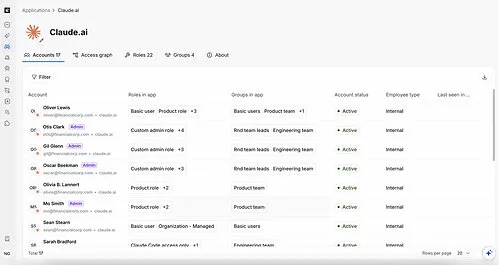
See accounts, roles, and permissions in Claude — A complete view of all accounts provisioned in Claude, the roles assigned to them, and the groups they belong to. Teams can filter directly to administrative roles and drill into the specific permissions each role carries, making it easy to identify over-provisioned access at a glance.
Review and certify access with Linx AI-powered recommendations — Launch access certification campaigns scoped specifically to Claude, reviewing who has access and what entitlements they hold. Linx surfaces recommendations powered by Anthropic's own models to help reviewers decide whether each access grant should be approved or denied, accelerating certification cycles without sacrificing rigor.
Identify and associate API keys — Full visibility into API keys created within Claude, including when each key was created and associated metadata, giving security teams the audit trail they need to detect stale or unmanaged keys.
Govern projects and resources — Monitorthe specific projects and shared resources within Claude, with an access graph for each project that maps exactly how access is provisioned: which roles exist, which users hold them, and how they connect.
"What makes this integration stand out is that access review recommendations are powered by Anthropic's own models. You're not just getting visibility into who has access to Claude — you're getting intelligent guidance on whether that access is appropriate," said Niv Goldenberg, CPO & Co-Founder at Linx. "Combining Linx's identity governance with Anthropic's AI to make faster, smarter certification decisions is exactly the kind of integration that moves enterprises from checkbox compliance to continuous, intelligent governance."
The Linx integration with the Claude Compliance API is available now. To learn more or see the integration in action, visit linx.security/demo.
About Linx Security
Linx Security is the AI-native identity security and governance platform built for the era of AI agents and non-human identities. Founded in 2023 and headquartered in New York, the company delivers unified visibility, continuous risk detection, and autonomous remediation across every identity in the enterprise — human, non-human, and AI. Backed by Insight Partners, Index Ventures, and Cyberstarts, Linx Security is trusted by identity-intensive enterprises globally to eliminate identity risk and provide AI governance without slowing the business. For more information, visit www.linx.security.
About Anthropic
Anthropic is an AI safety company building reliable, interpretable, and steerable AI systems, including Claude, an AI assistant focused on safety and helpfulness. Learn more at anthropic.com.
Media Contact

Linx Security Launches Agentic Access Control to Deliver Real-Time Governance Over AI Agents
NEW YORK, NY – June 9, 2026 – Identity security company Linx Security has announced the general availability of Linx Agentic Access Control, a real-time enforcement layer that gives security and identity teams granular oversight of every action carried out through the Model Context Protocol (MCP) — whether that action is initiated by a person, a non-human identity, or an autonomous AI agent. The announcement was distributed via PR Newswire.
The release extends Linx's existing unified identity platform — which already governs human and non-human identities — directly into the agentic layer. As the company explains, AI agents have moved beyond simply surfacing information and are now taking real actions inside business-critical systems: reading records, writing data, querying databases, and calling APIs. Conventional access controls weren't built to inspect or enforce policy on that kind of MCP traffic, and because those actions often don't appear in downstream application logs, security teams are left without visibility, without a way to allow or block actions at machine speed, and without an auditable record.
The announcement cites supporting data, noting that McKinsey's 2026 AI Trust Maturity Survey found nearly two-thirds of organizations point to security and risk as the top barrier to scaling agentic AI, with active mitigation trailing awareness. It also references NSA guidance on real-world MCP security risks, which recommends that access to tools touching sensitive or regulated data be explicitly controlled and segregated.
Per the release, Linx Agentic Access Control is built on an MCP Gateway that sits inline between AI platforms and the applications they reach, so every tool call is checked before it runs. The company highlights three core capabilities: tool-level enforcement that controls which specific read, write, and admin tools an agent can invoke; inline, real-time adjudication that approves or blocks each call before execution; and full audit logging that timestamps every action and ties it to the responsible identity. Linx frames its unified-identity approach — governing humans, non-human identities, and agents under one policy — as the key differentiator versus point solutions that handle agents in isolation.
The release includes commentary from Co-Founder and CPO Niv Goldenberg and VP Product Dor Renert, and notes the product is available now to Linx Security customers.
Linx Security Launches Real-Time Governance Platform for Enterprise AI Agents
NEW YORK, NY – June 9, 2026 – Identity security firm Linx Security has unveiled a new platform aimed at giving organizations real-time oversight of the autonomous AI agents now operating inside their systems, according to reporting from BriefGlance.com.
The product, called Linx Agentic Access Control, functions as an enforcement layer for the Model Context Protocol (MCP) — the increasingly common standard that lets AI systems connect to and act on business tools. As covered in the article, AI agents have moved well past simple chatbot duties and are now reading records, writing data, querying databases, and calling APIs within critical enterprise environments. Traditional access controls, built for human users and predictable machine identities, were never designed to monitor that kind of activity, creating what the piece describes as a governance vacuum.
The report points to mounting concern across the industry. A 2026 McKinsey survey found that roughly two-thirds of organizations name security and risk as the main obstacle to scaling agentic AI. The National Security Agency also issued guidance in May 2026 flagging risks tied to MCP, including uncontrolled automated actions and context poisoning, and recommended tighter controls around tools that touch sensitive data.
According to the coverage, Linx's approach routes every action an agent attempts through an inline MCP gateway, where it is inspected and either approved or blocked before execution. The platform offers tool-level permission controls, real-time adjudication, and full audit logging — capturing and timestamping every action and tying it back to the originating identity. Notably, Linx integrates these capabilities into its broader unified identity platform rather than treating AI agents as a standalone problem, which the article frames as a key differentiator against legacy IAM vendors.
The piece, written by Matthew Richardson for BriefGlance.com, also situates the launch against a backdrop of tightening global regulation — including the EU AI Act, GDPR, and sector-specific mandates — where the ability to produce a complete audit trail of agent activity is becoming a compliance necessity rather than a nice-to-have.
Sign up to get new articles & updates from the Linx team sent straight to you.