

Access Reviews Ready for Financial Software's Sensitive Compliance Needs


- Access reviews now cover service accounts, AI agents, contractors, and vendors, not just employees once a quarter.
- Financial customers expect SOC 2, ISO 27001, or PCI evidence from their software vendors, so many teams are effectively always in an audit cycle.
- Reviews built on HR exports and spreadsheets miss non-human identities entirely and lead to rubber-stamped approvals.
- Script-based remediation can fail partway and still report success, leaving access in place and no evidence for auditors.
- Modern IGA unifies every identity in one view, automates review campaigns, and produces timestamped evidence for audits.
User access reviews used to be much simpler. They were generally only done once per quarter and focused on governing employee access. If an identity had excessive permissions, you would simply lower them. If an account was left in your system after an employee was offboarded, you would complete the offboarding process.
Fast forward to today, and the scope of these reviews and expectations of the teams executing them have expanded far beyond the capabilities of legacy tools.
The reviews no longer stop at employees, but now extend to any non-human identities in your environment, such as service accounts and AI agents, along with contractors and external vendors that your team is responsible for. This increased responsibility alone would be enough to cause headaches, but when combined with rising compliance pressures and the expectation of blazing-fast remediation with evidence, even the best security team can feel left behind.
Why financial software provider access reviews are so unique
Access reviews are not one-size-fits-all. The size of your organization, the sensitivity of your data, and the compliance pressures around your customers and industry all shape what your process looks like, and how often it needs to run. For security teams in financial software, the difficulty is kicked into overdrive by factors inside and outside of the business.
Compliance pressures for you and customers
One of the most obvious factors: strict compliance standards for your customers processing financial data.
Your customers in finance expect, and often require, specific compliance frameworks such as SOC 2, ISO 27001, or PCI when it comes to their vendors. Without this proof, they cannot complete their audits, and your company could be found in breach of contract. Service is often suspended until a fix is ready, and the customer relationship may be seriously damaged.
Audits, around the clock
Because of the harsh consequences on revenue and reputation and the growing list of responsibilities with them, user access reviews are omnipresent in day-to-day work for your team.
In a conversation with our team, one cybersecurity leader at a platform handling customer interactions and payments said, "We're on a perpetual audit cycle… I don't think a month goes by where we're not talking to some audit team,” with their team working to maintain PCI, SOC 2, ISO, C5, and more certifications.
With audits happening so frequently and taking up such a large chunk of your work in a given quarter, ensuring their success with smart pro-active security, review processes, and remediation workflows becomes incredibly important.
The who, what, and whAI is changing
Compliance frameworks are only becoming stricter over time, especially in a world where AI agents and non-human identities are beginning to outnumber humans in the workforce.
The truth: AI is being adopted across organizations faster than the security around it has evolved, especially in teams on the cutting edge of technology, as you see in the software industry. Your developers are possibly using AI-generated code to prototype and ship new releases faster, or your sales team may be using AI assistants to track and follow up on calls.
With so many agents in your environment, reviews are becoming more difficult than ever, as every human has been multiplied countless times by all their autonomous workflows and assistants.

Legacy approaches can’t meet these challenges
For too long, identity security teams have relied on “good enough” processes to complete their access reviews. In 2026, the challenges have become too large in scope and complexity for what worked even as recently as 5 years ago.
Spreadsheets spreading teams thin
The broken nature of legacy access reviews becomes clear from the inventory step. Teams are still gathering information by going directly to a source of truth, such as an HR database, and simultaneously going to the systems that teams use in their day-to-day work, like Salesforce, GitHub, or AWS, to export user rosters. This leads to delays in chasing down lists from owners in other departments and rubber-stamped approvals from outsiders who don’t understand entitlement names.
Once these lists are collected, they’re put into software like Excel, and VLOOKUP formulas serve as the glue binding together all of these lists. The contrast between the high-tech nature of financial software and the fragility of this review stage becomes immediately clear. Your team isn’t storing code on floppy discs or worried about the Y2K bug anymore, so why does your identity security program still have relics from the past?
Non-human and non-employee identities skip inventory completely
If the source of truth for your user access review is the HR database, that can be great for getting a list of employees at the moment of capture. The challenge is that the modern business goes far beyond a list of employees, their department, role, and email alias. Any identity that isn’t a traditional employee can be missed on this HR list, leaving AI agents or service accounts out, and external vendors to be misinterpreted.
This means all of these identities will be left out of your review unless you decide to take inventory and add them manually. For AI and non-human identities, this process could be extremely tedious without automatic tools, as these identities outnumber humans and can often have complicated or shared ownership and access profiles.
Manual or script-based remediation often fails
Once you’ve established what across your environment needs fixing, it then becomes time to remediate and gather evidence.
Manual processes allow for oversight and accuracy, but they can be extremely tedious, with one-by-one account deactivations that are subject to human error. As a result, many teams relying on legacy access review tactics will turn to scripts that automate some of this offboarding and remediation work. These automatic processes can be an improvement from a time-saving perspective if everything goes smoothly. Still, the increasingly complex identity landscape leads to script failures and false positives for successful remediation.
For example: if your team finds a partially offboarded user with five remaining active accounts in an access review, you might decide to run a script that removes these accounts. If this script were to fail and only offboard four of the accounts, this workflow would often be automatically marked as a success because the script finished. That false positive can become a headache during an audit as no evidence is generated and the problem never goes away.
How does Modern IGA help?
The more you look, the more it becomes clear that legacy identity governance solutions are not cutting it for financial software teams and their access review needs. Modern identity governance platforms like Linx were designed with these headaches in mind and can give financial software teams the tools to stand tall through audits.
See every identity and its context, all at once
Say goodbye to access reviews that start by going from app to app to app, downloading lists of users, importing them to Excel, and hoping that every account is covered.
Modern IGA tools give your team solutions like the Linx Identity Graph, which unifies identities of all kinds, across all of your environments into one easy-to-use interface.
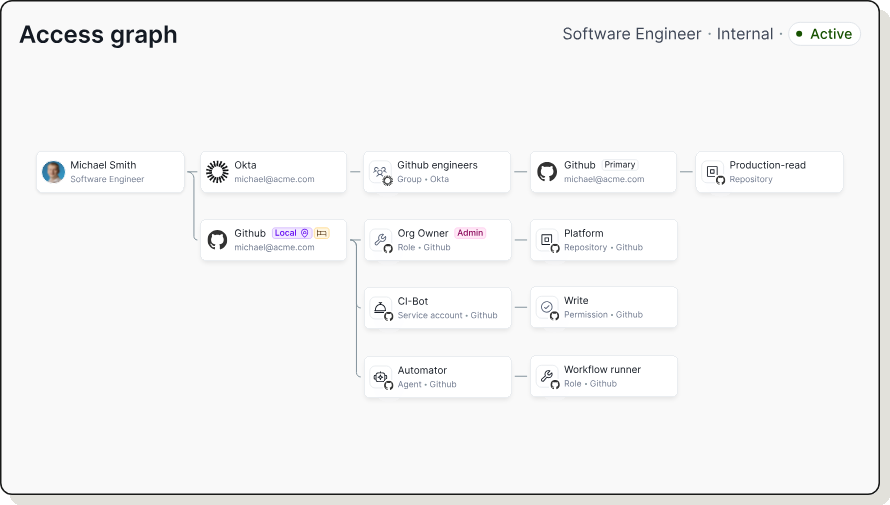
Every user, their identities, and the context in which their access exists are displayed in one place. By comparing which accounts users have and what they are allowed to access with other users with similar roles and titles, your team can get a complete idea of what someone’s access profile looks like, what access they should have, and how to remediate.
This all happens for human and non-human identities, without any complex setup, list importing, or manual remediation, but instead automatically.
Automatic and repeatable evidence creation for audits
This automatic remediation and enhanced visibility can be tailored to your user access review needs as well. Linx allows your team to create smart, repeatable, and automatic review campaigns that cut down long certification cycles to just one click, without any ticket triage or .csv handoff between teams.
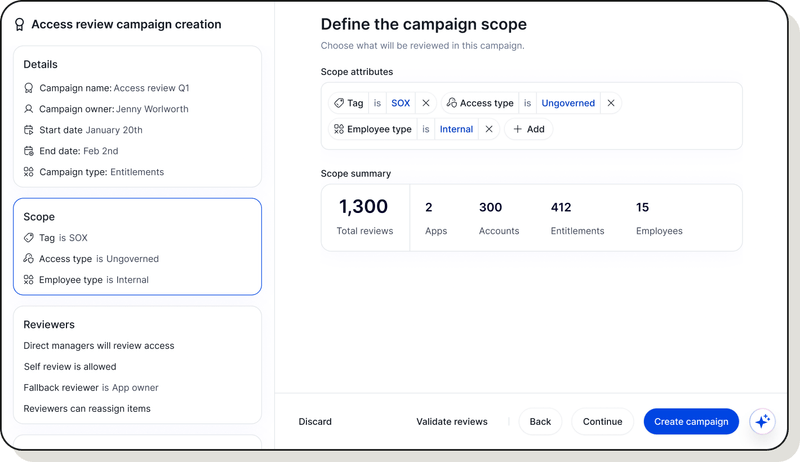
These campaigns can be built around your team’s specific review cadence, the compliance pressures in play, and the specific requirements and risks that Linx’s built-in AI assistant calls out in your system. Once it’s done and at-risk identities have been remediated, your team gets a complete and timestamped record to deliver to auditors and navigate even the strictest audit with confidence.
Our customer, monday.com, uses Linx for review campaigns related to their SOX and ISO compliance requirements. With 3,200 employees across 13 offices, this can be incredibly complex, but with Linx, their team was able to save over 300 hours per review cycle.
That’s seven and a half 40-hour work weeks, cut out of their review cycle, all because of a switch to modern IGA.
See how Linx can supercharge your access reviews
With every passing day, access reviews are becoming more difficult for teams that rely on legacy IGA platforms. Modern platforms like Linx don’t just allow you to catch up with your access review needs, but rather get ahead of today’s identity challenges.
Identity security teams at software companies that serve financial organizations have been seeing day-one value from Linx, with smart identity graphs, AI-powered automatic remediation, and user access reviews that are a breeze. They’re saying goodbye to spreadsheet reviews and manual remediation, and giving themselves more time to do the work that matters.
Ready to see just how much faster your reviews can be? Reach out to our team and get a demo to see for yourself.
What's next?