

Gartner Names AI Agent Identity a Top 2027 Technology Trend. Start With These Three Questions.

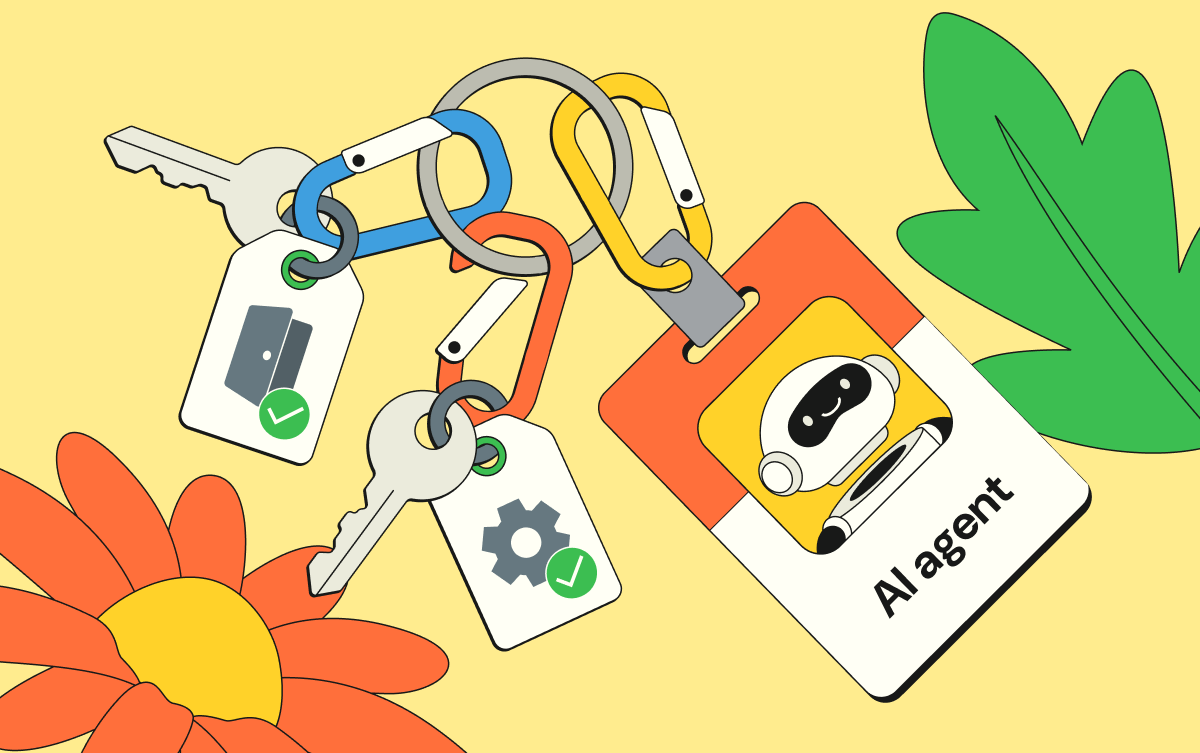
- Gartner’s Top Strategic Technology Trends for 2027 include both AI Context Platforms and AI Agent Identity, two developments that work best together.
- Gartner predicts that by 2028, 25% of enterprise breaches will be linked to AI agent abuse.
- Every agent should have a defined purpose, since that’s the baseline for judging whether its permissions are appropriate.
- Agents tend to become overpermissioned over time, and those using human credentials inherit access far beyond what their tasks require.
- Tool connections like MCP servers and delegation to other agents can quietly expand an agent’s reach into unexpected systems.
- Gartner recommends governing human, machine, and AI agent identities on a unified platform rather than in separate silos.
Gartner's Top Strategic Technology Trends for 2027 highlight two developments that belong together. AI Context Platforms (Trend #4) focus on giving agents the business knowledge they need to operate effectively, while AI Agent Identity (Trend #6) addresses how organizations govern agents as autonomous actors. Gartner predicts that by 2028, 25% of enterprise breaches will be linked to AI agent abuse, and that more than half of enterprise AI initiatives will halt through 2028 because of unresolved agentic identity challenges.
Together, these trends point to a fundamental shift. AI agents are moving from answering questions to taking action, and to operate effectively, they need context. But understanding risk requires more than business knowledge. It requires identity context: who an agent is, who it acts for, which tools and accounts it can access, and which other agents it can interact with. An agent's risk lives in those relationships.
Most enterprises are still working to establish that visibility. Ask how many AI agents are operating across the organization, what each one can do, and who owns them, and the answer may be incomplete.
Gartner's AI Agent Identity research offers a practical starting point with three questions every organization should answer: What is its role or purpose? What is it allowed to do? And where is it allowed to operate?
Question One: What is this agent for?
Purpose is often the first thing organizations lose sight of when deploying AI agents. A team builds an agent to automate a workflow, connects it to the necessary applications, and puts it into production. Its purpose may be documented in a project ticket or understood by the engineer who created it, but that information doesn't always reach the security team.
Gartner describes AI agent identity as a composite of changing elements, including model weights, system prompts, tool capabilities, and credentials, anchored to a unique workload identity. An agent's role, purpose, intent, and behavior must be considered alongside those elements because its capabilities and operational context can change over time.
Purpose establishes the justification for an agent's authority. Without it, organizations have no reliable baseline for determining whether its permissions are appropriate. An agent originally designed to summarize support tickets may eventually gain access to customer records, internal documentation, or automation tools. Each new connection expands its capabilities and potentially its risk.
Answering this question starts with knowing the agent exists. Organizations need visibility into which agents are deployed, what they're designed to accomplish, who owns them, and how their capabilities evolve.
Linx Security brings AI agents into the same identity security environment as humans and non-human identities. Agent records provide visibility into ownership, descriptions, capabilities, underlying models, and lifecycle status, helping security teams establish accountability and understand why an agent exists.
Once an organization's agents are visible and their purpose is defined, the next step is determining whether their permissions actually support that purpose.
Question Two: What is it allowed to do?
Gartner warns that the evolving nature of AI agents can lead to overpermissioning from their initial deployment. The pattern is familiar. An agent encounters a permission error, someone grants broader access to resolve it, and that access remains long after the immediate need has passed.
The problem becomes more complicated when agents operate through human credentials or inherit permissions from accounts with broader access than their tasks require. Gartner recommends that organizations stop deploying agents that impersonate human users or rely on credentials issued to employees.
Consider a coding agent responsible for fixing bugs in a payment application. It may need to read and modify code, execute tests, and review application logs. But those responsibilities don't necessarily justify permission to disable monitoring, change security alert configurations, or create privileged service accounts.
This distinction is particularly important for autonomous agents. Unlike traditional service accounts executing predefined operations, agents can determine how to accomplish an objective, select tools, and delegate work to other agents. Their permissions must account for the resources they can access and the authority those connections provide.
This is also where AI Context Platforms and AI Agent Identity intersect. Giving an agent access to relevant business information can help it complete a task, but that information shouldn't automatically expand its authority. An agent may understand how to execute a sensitive operation without being authorized to perform it.
Linx addresses this challenge through the Identity Graph, which connects agents to their tools, permissions, and related identities across enterprise systems. Where supported, these relationships also include other agents to which work can be delegated. This provides visibility into an agent's effective access rather than evaluating individual entitlements in isolation.
Least privilege remains fundamental, but enforcing it for autonomous agents requires understanding the relationships behind their access, not simply reviewing a list of permissions.
Question Three: Where is it allowed to operate?
As agents become more capable, they increasingly interact with enterprise systems through APIs, connectors, and protocols such as the Model Context Protocol (MCP). These integrations allow agents to discover and invoke tools across applications, but they also introduce additional credentials, permissions, and access paths.
Gartner identifies fragmented authentication practices and emerging agent protocols as challenges for organizations attempting to secure autonomous systems at scale. A single new tool connection can expand an agent's reach into applications and resources that security teams may not have anticipated.
Knowing that an agent can access an MCP server doesn't necessarily reveal every operation or downstream system available through that connection. Organizations need to understand which tools an agent can invoke, what resources those tools can reach, and which identities authorize those interactions.
The same principle applies to delegated workflows. A parent agent may have limited direct access to sensitive resources, but its connections to other agents can introduce additional paths into enterprise systems.
Linx provides visibility into the platforms where agents operate, the tools connected to them, and the systems those tools can reach. It also connects agent access to the accounts, groups, and roles authorized to use them, helping security teams understand where agents operate and identify potentially risky relationships.
Visibility, however, is only part of the challenge. Organizations also need ways to enforce access boundaries.
For supported interactions routed through Linx AI Access Control, authorization policies can restrict which MCP tools agents are permitted to use. This introduces an independent enforcement layer rather than relying exclusively on an agent's instructions to determine where it should operate.
As agent adoption expands, organizations need both visibility into an agent's reach and controls that help prevent its access from extending beyond approved boundaries.
Identity and context are the foundation of agent security
Gartner's inclusion of AI Context Platforms and AI Agent Identity among its top strategic trends highlights two connected requirements. Agents need business context to perform tasks effectively, while security teams need identity context to understand the authority and risk behind those tasks.
An agent with extensive business knowledge but poorly governed access can create significant risk. Likewise, an organization may have an inventory of AI agents without understanding how those agents connect to human identities, service accounts, applications, and other autonomous systems.
This is why AI-agent governance cannot operate as a separate security silo.
Gartner recommends unified identity platforms that govern human, machine, and AI-agent identities together rather than introducing fragmented controls for autonomous systems. Agents act on behalf of people, use non-human identities, and access the same enterprise applications already governed by existing identity programs.
At Linx Security, we believe securing AI agents starts with understanding those relationships. The Linx Identity Graph brings human, non-human, and AI-agent identities into a unified view, connecting identity ownership, access, and risk across enterprise systems. Linx AI Access Control extends that approach to supported MCP interactions, helping organizations enforce authorization boundaries around the tools agents use.
Together, these capabilities provide the visibility and control organizations need as autonomous agents become more deeply integrated into enterprise operations.
Gartner's three questions provide a starting point, but the answers need to reflect the complete identity environment. The organizations that successfully scale agentic AI won't simply be the ones deploying the most agents. They'll be the ones that can explain why each agent exists, what it's authorized to do, where it operates, and how it connects to the rest of the enterprise.
AI agents are changing how enterprises operate. Your identity security strategy needs to keep up.
Book a demo with Linx Security to see how unified identity governance and AI Access Control can help you secure human, non-human, and AI-agent identities from one platform.
What's next?